15 March 2026;        "Beware the Ides of March"
©  Cedric de la Harpe
Goto AR 07
AFRICANIST RESURRECTION 08
TO 2025 G20 EXTRAORDINARY COMMITTEE
Taste of Africa;
Barefoot Scientist,
Declares War on Inequality Emergency.
Cedric R de la Harpe
University of Knowledge – Soweto
H.v. Europeaus H. v. Afer3&5
GIVEBACK              “Kuwabweza”
ABSTRACT:
I believe that nothing can be more abstract,
more unreal, than what we actually see,
it is the unseen, that must be revealed.
Mining Investors Architects of Apartheid
The World is quite rightly of the opinion that Apartheid in evil,
I submit that what the World knows about Apartheid is the lesser evil. According to my 2022, to 2012 findings:
Findings 2011 to 2012:
Apartheid is not the greatest evil, the prime evil in the world, is “Economic Segregation”:
If it was not for what the English White Colonizer did to the Southern African Black Populations, (and here I include myself), our Black population groups would be the wealth of Southern Africa today, if not the wealth of the world.
I equate the damage that we have done to our black populations with the holocaust, and I ask the question; “Is the damage equal to, is the damage lesser than, or is the damage greater than? In my personal opinion,
I believe that the damage is greater than, and the world needs to heal, before we can even start repairing the damage we structured.
The Discovery of Diamonds, is the launch of “Economic Segregation, the European was not going to share the wealth with the Indigenous Populations, and every act and omission by the European, that takes place from the discovery of diamonds, is aimed at segregating the black from the wealth being extracted, while creating a scenario where they are forced to work for the European, when the European so required the Africanist to work, else, the Africanist was condemned to survive, as no animal has ever been called upon to do.
Diamonds are discovered in Kimberley 1871, followed by the First Monopoly-Capital in South Africa March 12, 1888,
De Beers Consolidated Mines Limited was formed on March 12, 1888, in Kimberley, South Africa, by Cecil Rhodes and Barney Barnato, merging their competing diamond mining operations into a near-monopoly. Financed by Alfred Beit and N M Rothschild & Sons, the company consolidated the Kimberley and De Beers mines, controlling roughly 90% of global production.
The Diamond Discovery in Kimberley, 1871, and the influx of black people seeking to earn a living, will bring the 100-year Frontier-War to an abrupt end, as the English bring in the Lee-Harvey Enfield, rifle,
The English cultivate support from the Khoi-San and Coloured / Griqua communities, plus the Mfengu group, who combined become the Cape Mounted Rifles, and use the Scorched Earth tactic to drive them off their lands.
The English introduce the Lee-Harvey Enfield rifle in 1879, and the Cape Mountain Rifles, could kill a rabbit from a mile away, this effectively ends the War of Dispossession, using their dark-skinned allies, armed with the Lee-Harvey Enfield rifle, to assassinate the Chiefs and leaders of the tribes, and then offering the successors a ‘peace agreement’, and locking them up in virtual cages, under supervision of Native Commissioner.
I submit that the native nations of Cafreria, based in the Eastern Cape, who from 1879 would be known as the Xhosa, through the establishment of a common language, taught through the missionary schools.
Between 1652 and 1879, Genocide has been committed on the native nations of Cafreria, based in the Western Colony and Eastern Cape.
The Xhosa tribes were defeated and placed in their allocated Native Territories late 1878 and 1879, and thanks to the Lee-Harvey Enfield and the Cape Mounted Rifles, the Zulu’s were defeated, and all the groups in Zulu-Land and the old Natal, were overpowered, and placed into their tribal groups by 1879.
Having achieved control of the ‘Black Problem’ the English now needed to created legislation that would allow the control over the blacks:
The Glen Grey Act of 1894 was a pivotal piece of legislation in the Cape Colony, engineered by Prime Minister Cecil Rhodes to enforce segregation, force Black Africans into wage labour, and limit their political rights. It introduced individual land tenure (replacing communal systems), imposed a labour tax, and established local councils, serving as a precursor to 20th-century apartheid policies.
This dissertation, when covering the 1970s, I will show how the Conservative Afrikaner was side-lined, and now I show how the bourgeoisie Afrikaans speaking community, back in 1894, joined the Monopoly-Capital, to introduce one of the evillest pieces of Legislation, that already traps the black populations, in the Colonizers defined Native territories, this is the final nail in the coffin, and the start of Genocide.
Supporting Coalition: Rhodes relied on the support of Cape Afrikaners, particularly the Afrikaner Bond party, whose leaders (like J.H. Hofmeyr) favoured segregationist policies. This alliance of British imperialists and rural Afrikaner interests (bourgeoisie) supported the Act as a means to ensure a cheap labour supply and consolidate white political control.
Key aspects of the 1894 Act include:
Land Tenure & Inheritance: The act replaced communal land ownership with individual quitrent plots (approx. 4 morgen), restricting ownership to one plot per person. It introduced primogeniture, ensuring only the eldest son inherited land, which forced younger sons to seek work elsewhere.
Forced Labour: To address labour shortages on white-owned farms and in industries, a “labour tax” was introduced for men who did not work for a portion of the year, notes this article from Sabinet African Journals.
Political Disenfranchisement: The act restricted the political power of Black Africans by creating separate local councils (the Glen Grey Council) and excluding landholders under this system from the general Cape parliament voter roll.
Territorial Segregation: Rhodes aimed to create separate areas for Black and white development, which he famously termed “a Bill for Africa”.
Initially applied to the Glen Grey district, it laid the framework for future segregationist land policies throughout South Africa, according to South African History Online.
“A look at the Africanist in 1870”
In my earlier writings I refer to and 1870, manuscript, of an English Lieutenant Cunyghame, in his book, ‘My Command in South Africa’, here we have a H.v. Europeaus, describing his observations and interactions of the H.v, Afer, and what impressed him with regard to their level of development, and business acumen, I quote an extract in Italics, include bold emphasis, and comment in regular.
At Port Elizabeth the rate of labour was often higher than at Cape Town, no less than 7s. a day, or even more, being paid to the native Kafir for unloading lighters. Here was a contrast which afforded me an opportunity for some professional reflections. The subaltern officers under my own command, many of whom had paid nearly five hundred pounds fur their commission, exclusive of their education and other expenses, were receiving from the State only 5s. 3d. daily per day; and a Suffolk labourer would be locked out for dreaming of asking more than 13s. a week.
Comment: The South African H.v. Afer, was being paid 7 s, (English Shillings) per day, ‘or even more’, when the subaltern officers under his command, notwithstanding their education and experience, were only being paid 5s, 3d. (5 shillings and 3 pence), back in England, a Suffolk labourer, would be locked out for dreaming of asking more than 13s a week.
The South African, in South Africa, was being paid nearly 3 times more than a white labourer in England,
These natives are learnt to be very clever and cunning.
Comment: Lieutenant Cunyghame gives the African population, credit for having been cultivated ‘to be very clever and cunning’ and I submit, that he saw the local population different to the European, with a behavior pattern almost described as Linnaeus, “sly, sluggish, neglectful”, Cunyghame is identifying that the local had the ability to think, and the European not.
It is stated that when the florin first came into use, a Scotchman of Port Elizabeth paid his Kafirs in florins instead of half-crowns. The natives were not long in finding out the trick, and now the florin is universally known amongst them as the “Scotchman.”
Comment: The florin was a new coin, almost the same size as the half-crown, that was worth 2 shillings and 6 pence, but the florin was only worth 2 shillings, and the Scotchman, was using the florin, in place of the half-crown.
The wages of the native servants are so high, and they are so independent that I heard it was sometimes difficult to get a washerwoman even at 5s. a day.
I had made inquiries as to the best means of proceeding to Grahamstown, eighty miles distant. No less than 40pd[2]. was asked for the hire of a carriage to convey myself and staff this short distance. I had therefore taken the precaution of directing commissariat carts and mules from King William’s Town to meet us.
On the following morning, as we were leaving, we observed the milk-boy going his rounds. His manner of carrying the milk deserves mention. Over his head he placed a sack with a hole fur his head, and one for each arm. At both front and rear were seen rows of pockets, in each of which he had placed a bottle of milk- – milk at the Cape being invariably sold by the bottle.
The Cape Cart is an institution in South Africa. It is perfectly astonishing what it will hold and over what roads it will travel. Ours was a cart on two wheels with two seats it was drawn by six mules, excellent animals.
In addition to myself and two officers, it carried the driver, a large amount of baggage, three rifles, two fowling-pieces, and a plentiful supply of ammunition.
In the second cart we placed our tent and various boxes of preserved meats. These provisions are absolutely essential in South Africa, whenever a journey is to be undertaken, if the slightest deviation is to be made from the high road, or beyond the immediate vicinity of the large towns.
We thus travelled more comfortably and less expensively, though scarcely in so expeditious a manner as we might have done in the regular stage-coach.
President Ramaphosa, as President of G20 2025, you are called upon to request your esteemed committee, to explain to Sub-Saharan Africa, why the worker, the popular group, as described by Cunyghame, were extruded from the economy.
During 1870, according to Cunynghame, in his book, ‘My Command in South Africa’, our male labour were charging 7 English shillings per day for their labour, our woman 5 English shillings per day, while in Suffolk England, a white labourer would be locked out, if he even thought about asking for more than 13 shillings per week.
Importantly, we need to absorb into our minds, this value that the African male had attached to his worth, the 7 English shillings per day rate, would be about £6 pound per month, or, £72 per annum.
The indentured Indian labour was only paid £2 per month, £24 per annum, and this was far more than they were able to earn in India, so there was no shortage of supply.
Let us just divert to why I accuse the mines of
using controlled slave labour to ensure profits.
“During 1921, daily mine wage was 26.1 penny/shift.”
“During 1930, daily mine wage was 25.7 penny/shift.”
“During 1936, daily mine wage was 27.0 penny/shift.
Over fifteen years, the annual mine wage increased from £30.08.00 per annum, to £31.12.00s per annum, an increase of 0,027% per annum.
The Municipalities in Transvaal, Orange Free State, and Natal, using the same South African labour supply were paying £32.10.00, only 4% more than the mines.
Note, in 1936, the mines are paying, £31.12.00s per annum, when, in 1870, some 66 years earlier, as per Cunynghame, in his book, ‘My Command in South Africa’, the African in the Eastern Cape, attached a value to his labour, at £72 per annum.
Pre-1902 Mine Labour
During the time-line, 1896/1897, 55,500 labourers were employed on the gold mines, of which, for this purpose, I only address the Transvaal contingent, 18% of the total, equal to 9 900 mine labourers. (66,6% were from Mozambique, and 5% from the Eastern Cape).
This is 16 years before the 1913 Native Land Act, 11% would have been from other parts of South Africa, 6 050 having arrived in Johannesburg, and sourcing labour directly from the mine office.
29%, 15 950 of the gold mining labour, pre-1898, had arrived and sourced work directly from the mine.
The gold mines are forced to close during the Anglo-Boer War, 1899 to 1902.
I ask the question, why did the gold mining industry discontinue using the Transvaal Black, and other walk in labourers after the Anglo-Boer War
I answer that question:
Very simply, in my opinion, the 15 950 black labourers, would only have accepted the employment, if they were paid ‘real money wages’, in 1902.
The English Coloniser had developed a system of ‘white collar crime’ where through the system of paying one community leader, thousands of young males, served both their community, and the white master, as his slave, a servant of the servant.
South Africa’s history is silent on this matter, however my answer, is one I sourced from the Zimbabwe uMthewakazi Review, as they reminisce on what happens to the Mfengu in Rhodesia, it is important to compare the South African developments from 1902, the Economic Segregation that takes place in South Africa, and observe that it is not driven by the Afrikaner.
I repeat from this publication that follows, Prof G R Ncube, reporting on the Zimbabwe labour, refers to the Mfengu labour of the Eastern Cape, the teachers, the preachers, the police, the clerks and the interpreters, how they are replaced by the whites, and how labour from the North is brought into Zimbabwe, to depress the real wages paid to the black by the Mining-Sector, under the English, the white issue is never an Afrikaner issue, it is directly related to Segregating the blacks from the economy.
Published: 19 June 2018 | by Ncube G.T., The Dyke
Extracted from the: The Dyke 2013 by Ncube G. T.
However, from this initial high wage period, lasting from about 1893 to 1906, real money wages paid to Africans in the colony began to decline markedly, particularly in the period between 1906 and 1922, to the extent that by 1922 African wages were lower than in 1904.
This development was related to the two historical factors.
The first was the huge influx of African labour migrants conscripted from British territories north of the Zambezi by the Rhodesia Native Labour Bureau from 1903 onwards.
It has been estimated that by 1922 labour migrants from the north constituted 68% of the total African wage labour force in Rhodesia.
The Mining Industry in South Africa, at the very same time, develops The “GNLB”
The Barefoot Scientist submits that in 1922, South Africa, had 60 000 of the total labour force of 160 000 37,5% while foreign national had 100 000 a total of 62,5%.
The net effect of this increased labour supply was a decrease in wage rates in all sectors of the fledgling economy.
The first notable effect of this development was a tapering off of Black immigration from South Africa.
From 1903 to 1923 the size of the immigrant Black South African population declined markedly. This was further compounded by the relatively high European immigration of 1907-11, when the White population of Rhodesia rose by 68% (Kosmin, 1977, 38).
Europeans soon took over most of the higher rung occupations previously held by the Mfengu, such as messengers, clerks, shop assistants and firemen, as these rapidly became White occupations.
The net effect of these changes was that the African in the colony was no longer wanted for anything except unskilled labour.
Africans were slowly forced out of skilled and well-paid jobs to make way for the new White immigrants.
The English will blame the Afrikaner for everything that happens to the Black in South Africa, but the Mfengu in Rhodesia, reminiscing on what happened to them, outlines the demise of the African, at the hands of the English Coloniser, the Economic Elite / the Latipac[3]
In Rhodesia, the Coloniser imports 68% of their wage labour from north of the Zambezi, in order to force African wages down, and increase profits, while migration of Africans from South Africa end, no longer can a South African black, move from the Imperialistic Powers that abuse and oppress.
Using the cheapest labour that could be sourced in Southern and Central Africa, the mining industry and their investors not only exploited the mineral wealth of the country, but, through the lack of allowing open, free participation, they have severely impacted on our still subjugated Black communities in 2025.
This highlights the obvious atrocities and abuses that the English Colonizer is guilty of, the one of suppressing the wages of the African, importing cheap slave labour, though the creation of community leadership that benefitted from commissions / gifts, and these community leaders, sent their young men, to serve the white master, on the mines, municipalities and industry.
These slave labourers, were labelled ‘Migrant Labour’ and the blacks were blamed for having developed the ‘migrant labour’ system, the poverty group, carry blame for everything that the colonizer did wrong.
After the Anglo Boer War, 1902, the mines had just started operating, when one morning, nearly forty-thousand men under Roberts moved into Johannesburg. The blacks on the streets celebrated, they tore up their Republican passes that had been issued, accepting that the defeat of the war, would bring them the rewards, that Chamberlain had used to justify the war, “Because of the ‘brutal and disgraceful’ treatment of the black population,” part of their motivation.
Within a week, that very same army that had come to liberate them, instituted the validity of the old ‘Pass Law’, re-established the old Republican mine police, the courts, and changed the Braamfontein Fort back into a jail, to hold those blacks that did not comply, aimed at keeping the blacks off the streets, forcing them into work, forcing them to build rail-lines, to bring coal to the mines, and move their exports to the sea.
Therefore, during 1902, the birth of influx and job control regulations, started, with old Transvaal the first to be forced to comply. The Native Affairs Department, established off the base of the Labour Recruitment agents, that had been providing mine labour from Mozambique, through the Kruger Park routes.
The mining industry used the reward system, commissions paid, which turned the labour supply into big business. Gifts and rewards paid to various Chiefs and Commissioners, increased the flow of labour into the Johannesburg area, the mines were faced with many labourers arriving directly, and not through a labour broker. This created unhappiness from the labour brokers, so structures and Native Commissioners, were put in place to avoid conflict.
The registration and pass laws, restricting the movement of black people was in place in 1902, ‘Apartheid’, and separate development, established in order to protect the huge profit potential, that the mining industry was generating, by using ‘controlled labour’ which had started with the Mozambicans, enslaved by their Portuguese Coloniser from 1450s, and then England pulled the British Protectorates into the labour-pool, followed by other African Colonies, resulting in a foreign labour contingent of 54% of the total labour force for 150 years.
By 1902, the Transvaal Province was divided into five labour areas, controlled by five Native Commissioners, charged with control of their people, as they established a system for the administration of justice, so that the new state could control the blacks on the land. Sub-commissioners attended to collection of taxes, issuing of passes, signing labour contracts, and some two hundred poorly paid Native policemen would ensure compliance. The mining industry, were using the Colonial government to control the black people’s movements.
Cedric Comment never seen elsewhere before:
I submit that the concept that it required 300 000 odd Common Wealth soldiers to defeat the 30 000 Boers, during the Anglo Boer War, was a con.
The war ends on 31 May 1902, and the Transvaal Africans are already in their cages, under sub-commissioner attended to collection of taxes, issuing of passes, signing labour contracts, assisted by two hundred poorly paid Native Policeman, who would maintain compliance, the English use over 200 000 of their soldiers, to divide South Africa, into cages for the Black People, in the Transvaal the sub-commissioners attend to collection of taxes, issuing of passes, signing labour contracts, Economic Segregation is in place.
For Clarity the Map reads as follows:
To accompany Annual Report of Commissioner of Native Affairs for 1902
NATIVE AFFAIRS DEPARTMENT
Sketch Map of the Transvaal showing the 5
Divisions under Native Commissioners and
the present stations of the Sub-Comisioners

During the period from 1909, the new Union of South Africa structures, decide to dispense with the Chinese indentured labourers, used from 1904.
To avoid any conflict in the labour market, the mining industry and the government, appoint a government labour recruitment agency, the GNLB as the South African Government Native Labour Broker, for all South African labourers to the mine.
By the end of 1910 the total number of Eastern Cape workers on the gold mines was approaching one hundred thousand, and the operations of the GNLB had expanded into the heart of the Transkei administration, establishing ten offices in the largest towns of the Transkei after 1908.
Historically, through till today, this is the local labour supply, established around the emancipation of the Mfengu.
They used the Mozambican ‘slave labour’ supply as the vehicle to suppress cost of labour from other areas, bringing Lesotho, a British Protectorate into the loop. Lesotho was a highly productive farming community, till their labour controllers changed them into a cheap labour supply.
By 1903, the mining industry employed forty-five thousand labourers, and only fifteen thousand from the Eastern Cape, the rest from Mozambique.
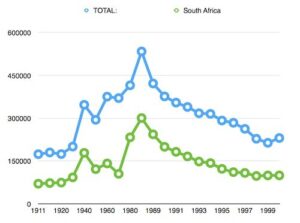
By 1910, the labour force had reached one hundred and eighty-thousand, of which South Africa provided only forty-thousand, mainly from the Transkei.
The graph that follows show top total labour, bottom South Africa labour:
Then, in 1911, a Labour Act was passed to make it impossible for the blacks, who were considered uncivilized, to do certain work on the mines. Much of this was the joint work of landowners, the mines and industry, manipulating the available labour.
Labour recruitment became part of a joint mining and government initiative, as they struggled to establish a system where wages of the labourer was kept to a minimum.
By 1903 pass offices existed in all major mining towns with four in Johannesburg. Finger printing was started in Johannesburg and spread to all offices.
In 1908 our new office in Driehoek was opened, and all migrants were processed here. When the workers arrived by train from Mozambique, Lesotho, and the Eastern Cape, they were shepherded here, driven in like cattle. Here a ‘senior white official’ through a translator would ask if the worker accepted the terms of the contract, the official’s signature was used as confirmation, should there be any dispute later.
Also important is that in 1921 two thousand whites were to be retrenched, following the economy down-turn after the world war. The whites believed that they were going to be replaced by blacks, so they protested, causing a war in Johannesburg, where seven thousand government troops reclaimed Johannesburg, and two hundred and fifty died. At this stage the English had no sympathy for the Afrikaner; the leaders of the strike were hanged, with hardly a trial. Strangely these poor whites were very socialist, yet linked to the capitalist by the colour of their skin.
In 1924 the Smuts government was removed, mainly by the white unionists who blamed him for being a tool of the big business.
Despite all the rhetoric of what the intentions were, the government admitted its intention to ‘counteract the force of economic advantages at present enjoyed by the ‘civilised’ native.
Ever since the early 1900s, the manipulation of Land, the usage of Labour on the mines was driven by the removal of the development being achieved by what they called the ‘civilised native’.
“The ‘civilised native that was invading the ‘white economy’.”
This 1924 ‘civilised labour policy’, coincided with the government talking nationalizing businesses, giving preferences to white employment, while at the same time restricting these poor whites progress through the same policy.
Through till the 1930s large numbers of poor whites, not all South African, were employed by government, increasing their ratio from 45 to 64 percent of the working force.
By 1940, the mining industry reached a new high, employing three hundred and sixty-thousand labourers, with South Africa Eastern Cape, the Mfengu Thembu base, providing the complement with one hundred and sixty-thousands of their young men.
President Ramaphosa, please forward this comment that I submit, is one of the main contributors to the “Inequality Emergency” initiative:
“Had the mining industry, used only South African labour in their total labour force, and paid them maybe 60% of the local blacks ‘own labour value’, South Africa as a nation, would be wealthier today, both black and white, and our country would be wealthier, only the mining investors, would not have extracted the wealth that they did from us?
Barefoot Scientist, Cedric R de la Harpe
University of Knowledge – Soweto
H. v. Europeaus H. v. Afer3&5
This qualification,is also my signature, shows a
European, H.v. Europeaus, whose mind-set is dominated
by the Sub-Saharan H.v Afer, #3 Behaviour, and
#5 Governance patterns, expressed through the
math' “to the power of” symbol.
| Eradicate Corruption to Eradicate Poverty |