Mining Investors Architects of Apartheid
(Human Dictate *page 107)
I return to the SA’s War Against Capitalism Consideration “1”:
Consideration 01/2; This follows from 01/1 on page 7:
South Africa is the workplace of 500 000 foreign workers, – not counting the hundreds of thousands who enter illegally to work.
Author Comment for Consideration 01/2:
I am not sure where the Author of SA’s War Against Capitalism obtained his figures of 500 foreigners being employed in South Africa in 1984, and then including as additional those who were working here as illegals, but this issue in one of the critical issues that the National Assembly needs to consider when Reviewing the Constitution, just what the contribution of the Economic Elite, the Neo-Liberal Philosophies by the Mining Investors had on the suppression of the labour wage rates.
*Economic Apartheid has always been part of our world history, however, once the English defeat the Boer in 1902, no longer would the black person receive real money wages in the colonies the mining industry control the political structures that administer their Colonies and protect the wealth extraction.
I quote a writing by Ncube G.T. here below, for the purposes on indicating that there was a time, when ‘real money wages’ was paid to the African.
Published: 19 June 2018 | by Ncube G.T., The Dyke
Extracted from the: The Dyke 2013 by Ncube G. T.
However, from this initial high wage period, lasting from about 1893 to 1906, real money wages paid to Africans in the colony began to decline markedly, particularly in the period between 1906 and 1922, to the extent that by 1922 African wages were lower than in 1904.
During 1870, according to Cunynghame, in his book, ‘My Command in South Africa’, our male labour were charging 7 English shillings per day for their labour, our woman 5 English shillings per day, while in Suffolk England, a white labourer would be locked out, if he even thought about asking for more than 13 shillings per week.
Importantly, we need to absorb into our minds, this value that the African male had attached to his worth, the 7 English shillings per day rate, would be about £6 pound per month, or, £72 per annum.
The indentured Indian labour was only paid £2 per month, £24 per annum, and this was far more than they were able to earn in India, so there was no shortage of supply.
Let us just divert to why I accuse the mines of using controlled slave labour to ensure profits.
“During 1921, the daily mine wage was 26.1 penny per shift.”
“During 1930, the daily mine wage was 25.7 penny per shift.”
“During 1936, the daily mine wage was 27.0 penny per shift.”
Over fifteen years, the annual mine wage increased from £30.08.00 per annum, to £31.12.00s per annum, an increase of 0,027% per annum.
The Municipalities in Transvaal, Orange Free State, and Natal were paying £32.10.00, only 4% more than the mines.
Note, in 1936, the mines are paying, £31.12.00s per annum, when, in 1870, some 66 years earlier, the African in the Eastern Cape, attached a value to his labour, at £72 per annum.
Using the cheapest labour that could be sourced in Southern and Central Africa, the mining industry and their investors not only exploited the mineral wealth of the country, but, through the lack of allowing open, free participation, they have severely impacted on our still subjugated Black communities in 2025.
This Chapter, highlights the obvious atrocities and abuses that the English Colonizer is guilty of, the one of suppressing the wages of the African, importing cheap slave labour, though the creation of community leadership that benefitted from commissions / gifts, and these community leaders, sent their young men, to serve the white master, on the mines, municipalities and industry.
These slave labourers, were labelled ‘Migrant Labour’ and the slaves were blamed for having developed the ‘migrant labour’ system, the poverty group, carry blame for everything that the colonizer did wrong.
I am of the opinion that the mining industry, was the architect of Apartheid, and the main influence that controlled separate development through to 1994 and beyond, this is confirmed by Anglo American SA, they stop investing when Jacob Zuma becomes ANC President, and the promises to reinvest, when their man, Cyril Ramaphosa, takes control of their selected ‘tribe’ again, their ANC.
I submit that Jacob Zuma was not part of the Mining Industry selected ANC leaders, and thus the anti-Jacob Zuma campaign by the Country, when he came into power. This is confirmed by Anglo American, as they contribute to restoring their selected ANC, under President Ramaphosa.
MINING INDABA KEYNOTE ADDRESS
Norman Mbazima, Deputy Chairman of Anglo American SA
5 February 2018
In December last year, the South African Chamber of Mines published a report on mining investment in South Africa, which shows that:
* Gross fixed investment in mining has been stagnant since 2009, and has declined by 5% over the course of the last three years;
* While net investment has declined by 57% since 2008;
- And despite commodity prices improving by about 11% on average since 2006, our output as an industry has been stagnant;
o I want to argue—and I hope I am preaching to the converted here—that we urgently need to get investment back on the agenda for South Africa.
o In this regard, it was encouraging to see how the internal rules and processes of the African National Congress, South Africa’s governing party, were observed even during a hotly contested elective conference last December. This resulted in a credible outcome, which we think is a significant ‘first step’ towards stabilising the political dynamics in our country.
o As the country prepares for its 5th democratic election, which will be held next year, we look forward to an exciting period of debate and democratic contestation.
o Our view is that if the right choices are made, South Africa will regain its momentum and this will bring together all social partners—government, business, labour, and civil society—and provide a renewed sense of hope.
o At Anglo American we are clear on our position: we are in the business of mining, not politics. The people of each country in which we operate choose their leaders according to their processes. We will work with those leaders and are interested in the policies that are adopted and how those policies are applied.
The people of each country in which we operate choose their leaders according to their processes. We will work with those leaders and are interested in the policies that are adopted and how those policies are applied.
To my understanding, President Jacob Zuma was chosen as our leader, according to our processes, and yet, Anglo chose to disinvest. This Keynote address is tantamount to telling the voters of South Africa, to ensure that Anglo American’s selected candidate / party are successful, if we wish their investment.
Pre-1902 Mine Labour
During the time-line, 1896/1897, 55,500 labourers were employed on the gold mines, of which, for this purpose, I only address the Transvaal contingent, 18% of the total, equal to 9 900 mine labourers. (66,6% were from Mozambique, and 5% from the Eastern Cape).
This is 16 years before the 1913 Native Land Act, 11% would have been from other parts of South Africa, 6 050 having arrived in Johannesburg, and sourcing labour directly from the mine office.
29%, 15 950 of the gold mining labour, pre-1898, had arrived and sourced work directly from the mine.
The gold mines are forced to close during the Anglo-Boer War, 1899 to 1902.
I ask the question, why did the gold mining industry discontinue using the Transvaal Black, and other walk in labourers after the Anglo-Boer War?
Very simply, in my opinion, the 15 950 black labourers, would only have accepted the employment, if they were paid ‘real money wages’, by 1902.
The English Coloniser had developed a system of ‘white collar crime’ where through the system of paying one community leader, thousands of young males, served both their community, and the white master, as his slave, a servant of the servant.
South Africa’s history is silent on this matter, however my answer, is one I sourced from the Zimbabwe uMthewakazi Review, as they reminisce on what happens to the Mfengu in Rhodesia, it is important to compare the South African developments from 1902, the Economic Segregation that takes place in South Africa, and observe that it is not driven by the Afrikaner.
In this publication that follows, Prof G R Ncube, reporting on the Zimbabwe labour, refers to the Mfengu labour of the Eastern Cape, the teachers, the preachers, the police, the clerks and the interpreters, how they are replaced by the whites, and how labour from the North is brought into Zimbabwe, to depress the real wages paid to the black by the English, the white issue, is never an Afrikaner issue, it is directly related to Segregating the blacks from the economy.
Published: 19 June 2018 | by Ncube G.T., The Dyke
Extracted from the: The Dyke 2013 by Ncube G. T.
However, from this initial high wage period, lasting from about 1893 to 1906, real money wages paid to Africans in the colony began to decline markedly, particularly in the period between 1906 and 1922, to the extent that by 1922 African wages were lower than in 1904.
This development was related to the two historical factors. The first was the huge influx of African labour migrants conscripted from British territories north of the Zambezi by the Rhodesia Native Labour Bureau from 1903 onwards. It has been estimated that by 1922 labour migrants from the north constituted 68% of the total African wage labour force in Rhodesia.
The net effect of this increased labour supply was a decrease in wage rates in all sectors of the fledgling economy. The first notable effect of this development was a tapering off of Black immigration from South Africa. From 1903 to 1923 the size of the immigrant Black South African population declined markedly.
This was further compounded by the relatively high European immigration of 1907-11, when the White population of Rhodesia rose by 68% (Kosmin, 1977, 38).
Europeans soon took over most of the higher rung occupations previously held by the Mfengu, such as messengers, clerks, shop assistants and firemen, as these rapidly became White occupations.
The net effect of these changes was that the African in the colony was no longer wanted for anything except unskilled labour.
Africans were slowly forced out of skilled and well-paid jobs to make way for the new White immigrants.
The English will blame the Afrikaner for everything that happens to the Black in South Africa, but the Mfengu in Rhodesia, reminiscing on what happened to them, outlines the demise of the African, at the hands of the English Coloniser, the Economic Elite.
In Rhodesia, the Coloniser imports 68% of their wage labour from north of the Zambezi, in order to force African wages down, and increase profits, while migration of Africans from South Africa end, no longer can a South African black, move from the Imperialistic Powers that abuse and oppress.
****
After the Anglo Boer War, 1902, the mines had just started operating, when one morning, nearly forty-thousand men under Roberts moved into Johannesburg. The blacks on the streets celebrated, they tore up their Republican passes that had been issued, accepting that the defeat of the war, would bring them the rewards, that Chamberlain had used to justify the war, “Because of the ‘brutal and disgraceful’ treatment of the black population,” part of their motivation.
Within a week, that very same army that had come to liberate them, instituted the validity of the old ‘Pass Law’, re-established the old Republican mine police, the courts, and changed the Braamfontein Fort back into a jail, to hold those blacks that did not comply, aimed at keeping the blacks off the streets, forcing them into work, forcing them to build rail-lines, to bring coal to the mines, and move their exports to the sea.
Therefore, during 1902, the birth of influx and job control regulations, started, with old Transvaal the first to be forced to comply. The Native Affairs Department, established off the base of the Labour Recruitment agents, that had been providing mine labour from Mozambique, through the Kruger Park routes.
The mining industry used the reward system, commissions paid, which turned the labour supply into big business. Gifts and rewards paid to various Chiefs and Commissioners, increased the flow of labour into the Johannesburg area, the mines were faced with many labourers arriving directly, and not through a labour broker. This created unhappiness from the labour brokers, so structures and Native Commissioners, were put in place to avoid conflict.
The registration and pass laws, restricting the movement of black people was in place in 1902, ‘Apartheid’, and separate development, established in order to protect the huge profit potential, that the mining industry was generating, by using ‘controlled labour’ which had started with the Mozambicans, enslaved by their Portuguese Coloniser from 1450s, and then England pulled the British Protectorates into the labour-pool, followed by other African Colonies, resulting in a foreign labour contingent of 54% of the total labour force for 150 years.
By 1902, the Transvaal Province was divided into five labour areas, controlled by five Native Commissioners, charged with control of their people, as they established a system for the administration of justice, so that the new state could control the blacks on the land. Sub-commissioners attended to collection of taxes, issuing of passes, signing labour contracts, and some two hundred poorly paid Native policemen would ensure compliance. The mining industry, were using the Colonial government to control the black people’s movements
Cedric Comment:
I submit that the concept that it required 300 000 odd Common Wealth soldiers to defeat the 30 000 Boers, during the Anglo Boer War, was a con. The war ends on 31 May 1902, and the Transvaal Africans are already in their cages, under sub-commissioner attended to collection of taxes, issuing of passes, signing labour contracts, assisted by two hundred poorly paid Native Policeman, who would maintain compliance, the English use over 200 000 of their soldiers, to divide South Africa, into cages for the Black People, in the Transvaal the sub-commissioners attend to collection of taxes, issuing of passes, signing labour contracts, Economic Segregation is in place
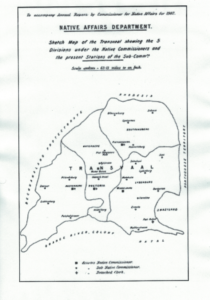
For Clarity the Map reads as follows:
To accompany Annual Report of Commissioner of Native Affairs for 1902
NATIVE AFFAIRS DEPARTMENT
Sketch Map of the Transvaal showing the 5
Divisions under Native Commissioners and the present stations of the Sub-Commisioners
During the period from 1909, the new Union of South Africa structures, decide to dispense with the Chinese indentured labourers, used from 1904. To avoid any conflict in the labour market, the mining industry and the government, appoint a government labour recruitment agency, the GNLB as the South African Government Native Labour Broker, for all South African labourers to the mine. By the end of 1910 the total number of Cape workers on the gold mines was approaching one hundred thousand, and the operations of the GNLB had expanded into the heart of the Transkei administration, establishing ten offices in the largest towns of the Transkei after 1908.
Historically, through till today, this is the local labour supply, established around the emancipation of the Mfengu.
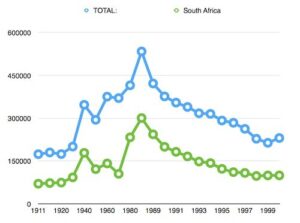
They used the Mozambican ‘slave labour’ supply as the vehicle to suppress cost of labour from other areas, bringing Lesotho, a British Protectorate into the loop. Lesotho was a highly productive farming community, till their labour controllers changed them into a cheap labour supply. By 1903, the mining industry employed forty-five thousand labourers, and only fifteen thousand from the Eastern Cape, the rest from Mozambique. By 1910, the labour force had reached one hundred and eighty-thousand, of which South Africa provided only forty-thousand, mainly from the Transkei.
The graph that follows show top total labour, bottom South Africa labour:
Then, in 1911, a Labour Act was passed to make it impossible for the blacks, who were considered uncivilized, to do certain work on the mines. Much of this was the joint work of landowners, the mines and industry, manipulating the available labour.
Labour recruitment became part of a joint mining and government initiative, as they struggled to establish a system where wages of the labourer was kept to a minimum. By 1903 pass offices existed in all major mining towns with four in Johannesburg. Finger printing was started in Johannesburg and spread to all offices. In 1908 our new office in Driehoek was opened, and all migrants were processed here. When the workers arrived by train from Mozambique, Lesotho, and the Eastern Cape, they were shepherded here, driven in like cattle. Here a ‘senior white official’ through a translator would ask if the worker accepted the terms of the contract, the official’s signature was used as confirmation, should there be any dispute later.
Also important is that in 1921 two thousand whites were to be retrenched, following the economy down-turn after the world war. The whites believed that they were going to be replaced by blacks, so they protested, causing a war in Johannesburg, where seven thousand government troops reclaimed Johannesburg, and two hundred and fifty died. At this stage the English had no sympathy for the Afrikaner; the leaders of the strike were hanged, with hardly a trial. Strangely these poor whites were very socialist, yet linked to the capitalist by the colour of their skin. In 1924 the Smuts government was removed, mainly by the white unionists who blamed him for being a tool of the big business.
Despite all the rhetoric of what the intentions were, the government admitted its intention to ‘counteract the force of economic advantages at present enjoyed by the ‘civilised’ native.
Ever since the early 1900s, the manipulation of Land, the usage of Labour on the mines was driven by the removal of the development being achieved by what they called the ‘civilised native’.
“The ‘civilised native that was invading the ‘white economy’.”
This 1924 ‘civilised labour policy’, coincided with the government talking nationalizing businesses, giving preferences to white employment, while at the same time restricting these poor whites progress through the same policy. Through till the 1930s large numbers of poor whites, not all South African, were employed by government, increasing their ratio from 45 to 64 percent of the working force.
By 1940, the mining industry reached a new high, employing three hundred and sixty-thousand labourers, with South Africa Eastern Cape, the Mfengu Thembu base, providing the complement with one hundred and sixty-thousands of their young men.
Had the mining industry, used only South African labour in their total labour force, and paid them maybe 60% of their ‘own labour value’, South Africa as a nation, would be wealthier today, both black and white, and our country would be wealthier, only the mining investors, would not have extracted the wealth that they did from us?
“Review Prayer 04”.
Today, 30 years into our New Democracy, South African Mining, still using the Mine Labour Broker system, sharing the labour complement. 33% Eastern Cape, 33% Mozambique, 33% Lesotho, has been able to restrict the poverty South African labourer from entering the labour market, and while the arrangements with the ‘home leaders’ is maintained, the suppressed labour wages will remain, my prayers are for the Constitution Review, to restrict the Mining Industry, from using Foreign Nationals, and not allow the Umtata structure, also a link that suppresses wages, to continue in its existing form.
I submit that the 1913 Native Land Act, becomes a formality, for a system that is designed to ensure that Black population do not find the level of mining and industry that is taking place, and the foreign nationals that are being used by the Mining Sector.
***
RAND VALUE: Human Dictate page 131
Comment: In Politics you will always hear “If you don’t know where you come from, you can’t move forward”, this is some of the History important for the GNU National Assembly before we can move forward
A few days back, I venture into Twitter briefly, and I am attracted to a tweet that reflects the Rand / Dollar historical change rates, and it questions everything I have written before, it questions the honesty of my writings, and it questions the honesty of every person that considers themselves, a slight bit more educated than me, a slight bit more intelligent than me.
My first port of call is one of my many sons, and my question is “Who sets the exchange rate, and why do we have no control over the exchange rate.”
The question results in a heated discussion over the concept, that our politics causes the value of the Rand to decrease, my comment that the exchange rate was the most stable from 2008, when Jacob Zuma becomes President of the ANC, and then the Country in 2009.

This answer causes me to analyze the Rand exchange versus the Political issues, and I discover that Politics can’t have the influence that it is credited with, and brief comment is as follows
1976 Soweto riots, does not affect the Rand.
1990 Mandela freed –
rate moves from R 2,59 to R 3,55 by 1994.
1994 rate moves from R 3,55 to R 6,12 by 1999, during the President Mandela term
1999 rate moves from R 6,12 to R 8,26 by 2008, during the President Mbeki’s two terms
2009 rate improves from R 8,42 in 2008, to R 8,20 by 2012 during the President Zuma’s first term
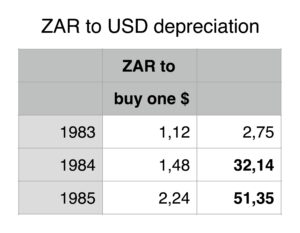
Let us have a look at one important political date, 1983, the new constitution bringing us the Executive State President and Tri-Cameral Parliament in 1984, and the introduction of the Free Market system, and we note, that from 1983 to 1985, the ZAR / USD exchange rate has the first major leap, over two years our ZAR loses 50% of its value, moving from R 1,12 to R 2,24 to the USD.
Let us have a look at the Gold Mining Industry labour trends and the motivations for change?
Chart 1
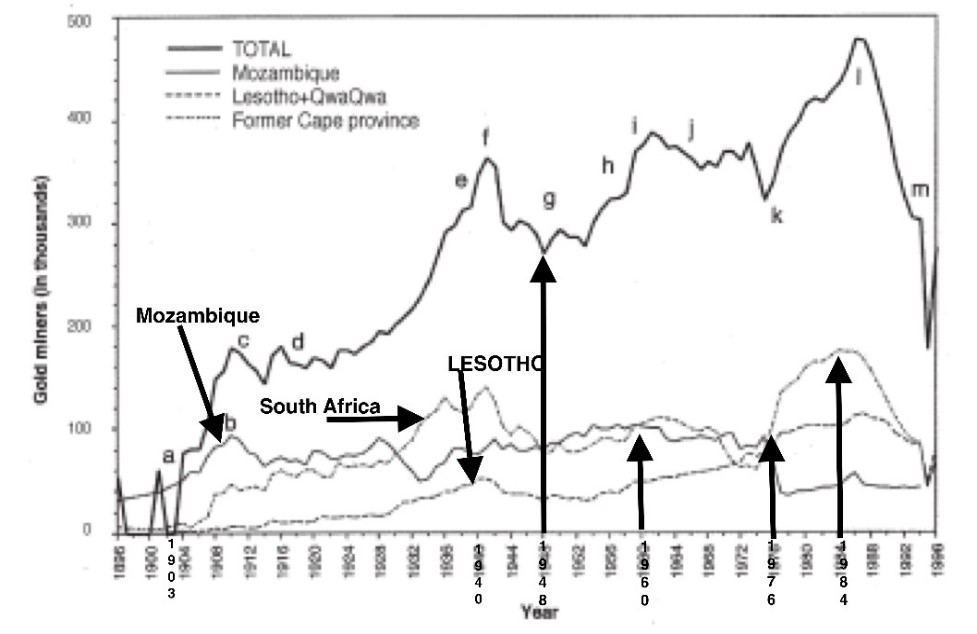
Until this morning, I interpreted the reduction of labour as depicted on the chart 1, (l to m 1985 to 2000) as the mining industries decision to mechanise, to remove the need for too many black workers, while the labour complement reduces by 37,5%, the value of the output between 1985 to 2000, according to a mining report, increased by more than 250%.
I assumed that mechanisation, resulted in improved production, and thus the increased value, how else could output just increase by 250% in fifteen years with the mining report not identifying the real reason
What the mining report does not show, is that the production dropped by 40% during this period, production drops by 40% and value increases by 250%, what happened to the Gold Price?
On the next page, I show the Fig 1, regarding the following trend;
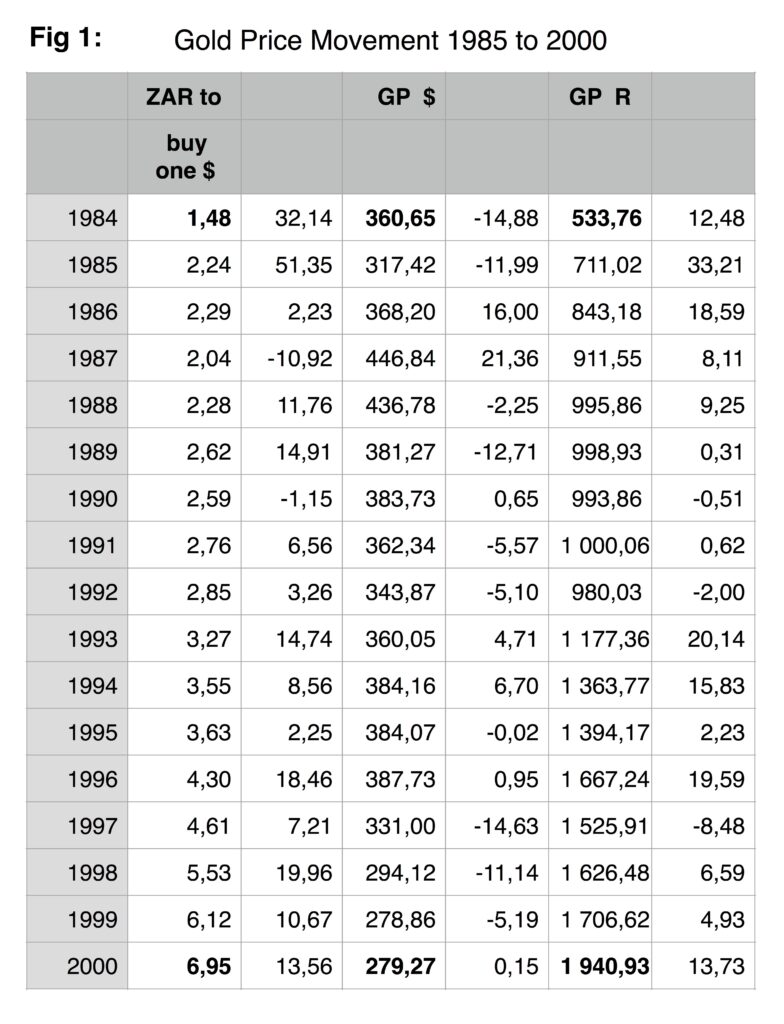
** The Gold Price in USD reduces from 360,65 to 279.27, a 22,56 percent reduction, yet the 250% increase in value as reported in the mine report, does take place, in the interest of the mining shareholders.
** The Gold Price in ZAR, South African rand, moves from R 533,76 to R 1 407,17 a 263,64 percent increase, confirming the mining industry claim in the report.
What is the cause of this phenomenal increase, an increase when the world gold price reduces, yet still allows the mining industry shareholders to benefit, at no abnormal cost to the investors, very simply the manipulation of the Rand / USD exchange rate?
As the Western World moves into the Free Market system, in the early 1980s, the third world, emerging countries exchange rates are manipulated by the System, supposedly as the result of political unrest and instability, but this is no more than the new age system of continued raping of our economy by the System Dictate.
The USD to ZAR, South African rand, moves from R 1,48 in 1984, to R 6,95 in 2000, a 369,59 percent depreciation.
And I repeat, the Gold Price in ZAR, South African rands, moves from R 533,76 to R 1 407,17 a 263,64 percent increase, confirming the mining industry claim in the report.
The gold mining labour, the humans are reduced by 37,5%, some 100 000 humans losing their employment, yet the mining investors gold output, increasing by the Gold Price in ZAR, South African rand, moving from R 533,76 to R 1 407,17 a 263,64 percent increase.
Any investor in the gold mining industry, or gold mining shares, and all descendants of their families, should be ashamed, should apologise to all South African citizens, and not just the human, as the depreciation of the Rand, directly impacted on the removal of income from every citizen of South Africa.
Any person whose filters of the mind are starting to open, should express antipathy to all those who have suffered through the greed of the Free Market policies of self-enrichment, the exchange rate resulting in all our imports affected, our cost of living, becoming impossible.
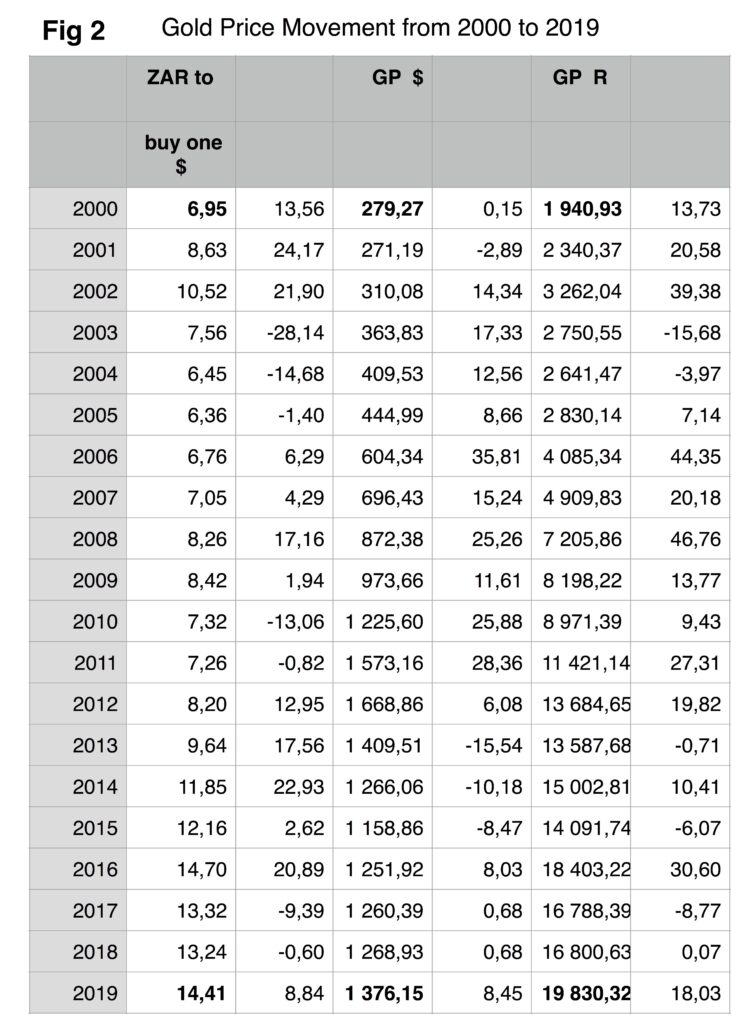
We know look at how the Gold price moves from here. (See Fig 2,)
South Africa economy had already been raped by 2000, under the control of the South African Presidents from 1984, to 1994, P.W Botha, and F.W, de Klerk, Nelson Mandela, and from then, by Thabo Mbeki, Cyril Ramaphosa, (here I exclude Jacob Zuma he carries enough blame for his part)
From 2000 to 2019, the Gold Price in USD increases from 279,27 to 1 375,14, a 392,76 percent increase, I congratulate the mining industry on achieving this.
Back home, the Gold Price in ZAR, South African rand, moves from R 1 940,93 to R 19 830,30 a 921,69 percent increase, this is wrong, wrong if an old man of 72, needs to discover this manipulation of our exchange rate, in the interests of the Latipac, while at the cost of the citizen.
The USD to ZAR, South African rand, moves from R 6,95 in 2000, to R 14,41, in 2019, a 107,20 percent depreciation.

Why do I submit that the manipulation of the Rand value, is wrong, almost criminal, and that South African Government and the mining industry shareholders, should be called to account and to compensate the citizens of our Country?
2009 Gold Forecast;
The report dated 2009, comes to my attention while investigating the President Jacob Zuma first term, I become aware of the serious implications of the forecast, however, my presentation that Gold is reaching a level of ‘uneconomic’ removal, and thus the Gold Investors will be moving on shortly, initially does not find space in Human Dictate, but in Revision 3, it does.
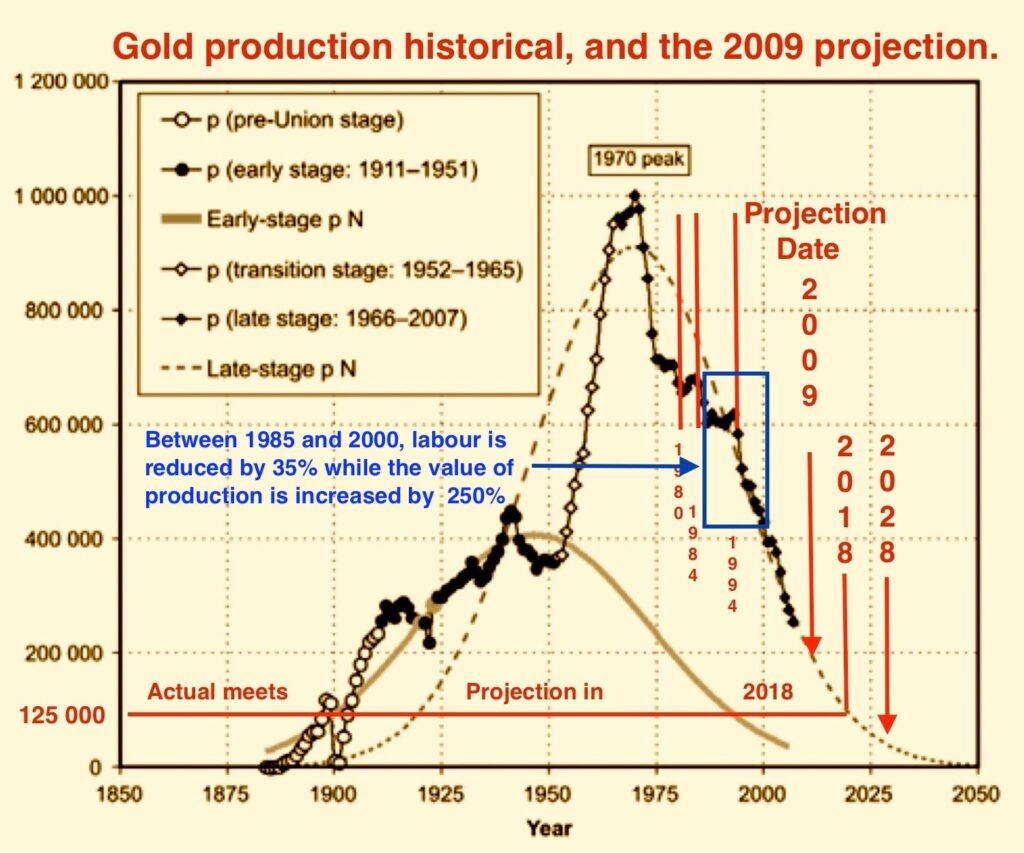
Cedric’s short ramble:
1: The 2009 projection, results in the Gold Price, moving from USD 973,66 to 1 668,86, by 2012, a typically related to diminished production.
2: The Rand remains stable during this period.
3: Gold Prices reduce, and Rand depreciates from 2013.
4: 2018, nine years after projection, production forecast of 125 000 is accurate, confirming serious implications.
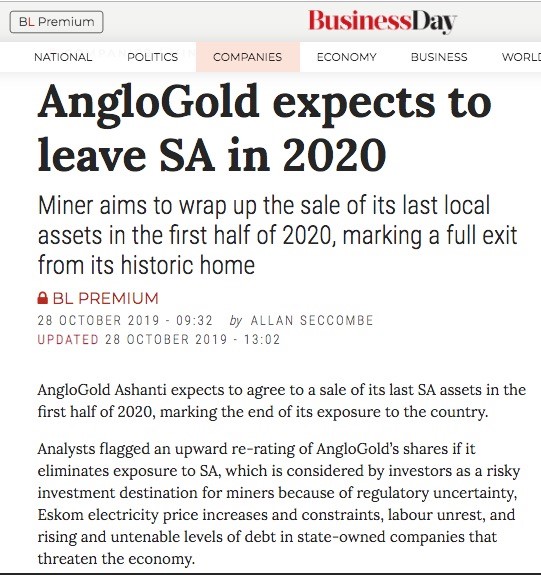
AngloGold Moving On
This Business Day report, dated October 28, 2019, typically blames the South African people and Government blame for moving on.
Let us have a look at the impact of the ‘investors’ comments on the Gold Price, and the Rand Exchange:
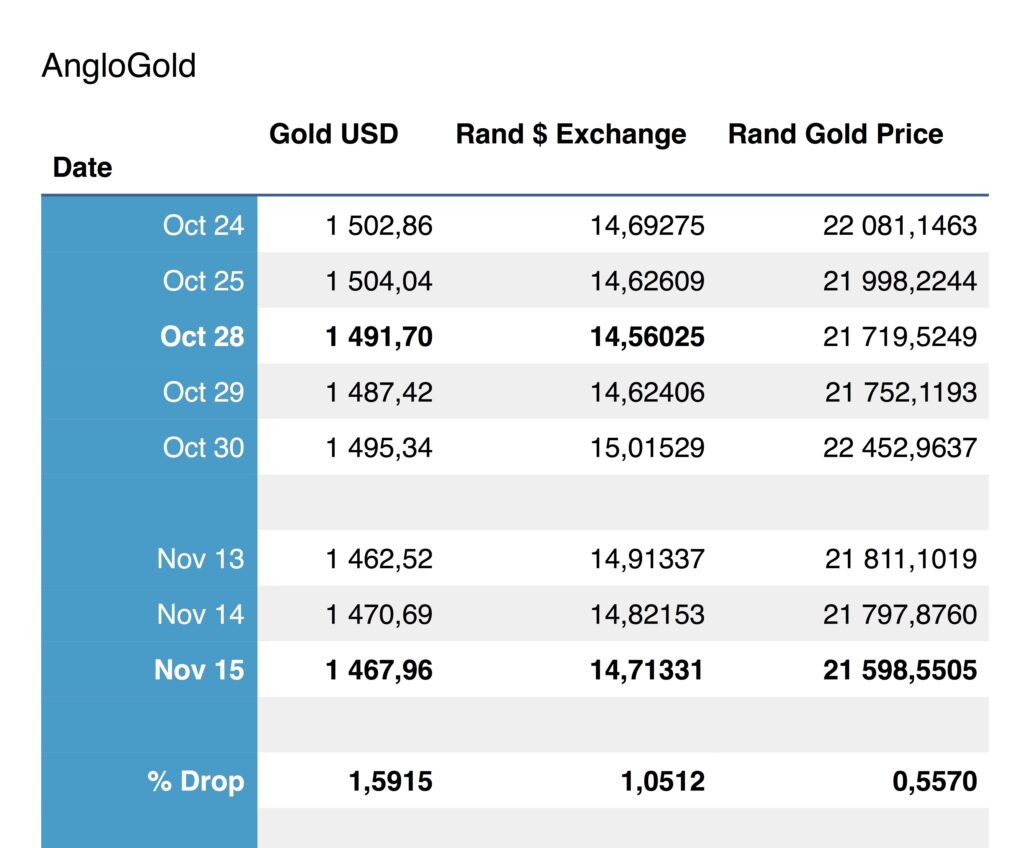
The Gold Price decreases by 1,59% from the announcement to Nov 15, unusual, in terms of potential production drop, the price should have increased.
The Rand exchange rate depreciates by 1,08% , yet the Rand Gold Price only decreases by 0,56%.
The Citizens pay, the Latipac, will play.
Now this presentation uses the labels to identify, just who is the beneficiaries of the Free Market manipulation, and who has been severely prejudiced through the increasing cost of living, through the manipulation of the Rand exchange rate, as our Government allowed us to move into the Free Market system, where the Latipac, and some latipac-generators benefited at our expense.
Prior to the Free Market, countries adjusted their currency exchange rate, to generate maximum wealth, for their county, from their resources, materials and labour.
All countries had a system of import and export tariff adjustments, Mercantilism, to protect their local production values, and in turn, maintain an economy, that protected the human, and Latipac-generators.
Donald Trump is moving towards Mercantilism, it is a national economic policy that is designed to maximise the exports, and minimise the imports, of a nation. These policies aim to reduce a possible current account deficit or reach a current account surplus.
Few people, scrutinising the Historical Chart South African Rand Rate chart repeated below, will ever believe that the Rand was as strong as it was, during the period 1971 to 1983, given that the Country had declared a Republic, changed its currency from English Pound to South African Rand, at an exchange rate of R 2 to one English Pound, and during this period, the June 16, 1976 student massacres takes place, without negatively impacting on the value of the Rand.
This control existed, the ‘State C.E.O. of Finance’, pretty simply, adjusted exchange rates, and import and export tariffs, in the interest of extracting maximum wealth, for the Country and its citizens.
I summarise the following 2018 Import and Export statistics, and submit the following Conversation / Enlightened Thinking points;
Why are our Import Categories, also our Export Categories?
Who else benefits from Export exchange rate, farmers etc
South Africa’s Exports and Imports off which our GDP is calculated.
The Beneficiaries of this system, 2018 figures:
1. Precious Metals 17.5%
2. Ores, coal, 12,5%
3. Vehicles 11,4%
4. Mineral Fuels 10.6%
5. Iron steel 6,7%
6. Machinery & Computer 6,2%
7. Fruit and Nuts 3,9%
8. Aluminium 2,2%
9. Electric machines equip 1,9%
10. Plastics 1,5%
The Citizen cost of living increased in this system, 2018 figures:
1. Mineral Fuels 18,2%
2. Machinery & Computer 12,3%
3. Electric machines equip 9,2%
4. Vehicles 7.6%
5. Plastics 3,0%
6. Pharmaceuticals 2,7%
The manipulation of the Rand/USD exchange rate, benefits the Latipac, a small percentage of the citizens of our country, and Citizens of other Countries, and due to the increased cost of imports, the poverty section cost of living is increasing to beyond break point.
The top five import categories, are all in the top ten export categories, a very questionable Free Market involvement, I submit that our manipulated exchange rate, is used by the Free Market structure, in order to extract increased wealth for the Latipac.
To the children and grandchildren of the Latipac, and all those who have taken advantage of their manipulation of the economy to capture 27% of the world wealth between 1980 and 2016, may I repeat the diagram and comment from an earlier chapter, by now, you should be embarrassed by your family’s wealth, embarrassed by their animal behaviour, you should start by apologising to the citizens of South Africa, in particular, those who are human?
From 1980 to 2016, during the Free Market period, the top 1% captured 27% of the total income growth, and the bottom 50%, only captured 12% of the total income growth.

Extrapolating from the diagram, it means that the 52,5 million people representing the top 1%, captured 27% of the total income growth, and the 2 512,5 million people, representing the bottom 50%, captured 12% of the total income growth, the income differential, is that the 1% captured 107,66 times more, than the 50% at the bottom.
Dear Latipac and descendants, I allege that you have captured 27% of the total income growth between 1980 and 2016, directly from the 90% of the lower end of the triangle, and the #LatipacMustFall, the #FreeMarketWillFall.
****
SUMMARY OF PRESENTATION SUPRA:
I have briefly touched on the informal economy, I have attacked the Mining Industry, for having used 54% of all labour from the foreign countries, causing the repression of wages throughout the Country, and the exit of 54% of all mine wages to leave South Africa for 150 years.
If the Mine Industry had not done that, the 54% of all mine wages would have been spent in South Africa, and Cedric, manufacturing shoes and furniture at stages, would be wealthy today, as would thousands more black businessmen in the Townships and Native Villages around the Country.
There is one more issue of importance for the National Assembly consider as you apply your minds to the Constitutional Review, and that is what the Mining Industry achieves between 1902 and 1903, a forerunner to, and what I submit a reason for the 1913 Native Land Act.
****
Post no 1; GiveBack to Nature
Post No. 3 South Africa Economy 1985
Post No 4. How was South Africa’s Economy Captured:
Post No 5 Implications for the working class
Post No 7 THE LAND
Post No 8, 1913 Native Land Act
Post No, 9 Food Chain Removed from the Blacks
Post No 10; Neo-Liberalism the Silent Philosophy
Post No 11; Neo-Liberalism English or Afrikaner
Addendum 01; Unshackle your Skills:
Addendum 03: Wealth Tax, Part 1
Addendum 03 Cont: Wealth Tax Part 2
Addendum 04 Neo-Liberalism Zombie