
15 March 2026;        "Beware the Ides of March"
©  Cedric de la Harpe
GoTo AR 03
AFRICANIST RESURRECTION 04
TO 2025 G20 EXTRAORDINARY COMMITTEE
Taste of Africa;
Barefoot Scientist,
Declares War on Inequality Emergency.
Cedric R de la Harpe
University of Knowledge – Soweto
H.v. Europeaus H. v. Afer3&5
GIVEBACK              “Kuwabweza”
ABSTRACT:
I believe that nothing can be more abstract,
more unreal, than what we actually see,
it is the unseen, that must be revealed.
SOUTH AFRICA BEFORE THE CRUCIFIXION
I quote in italics, and identify items that we should consider, and then make my comment for discussion in regular:
SOUTH AFRICA OF 1985, as stated by the Neo-Liberal Economic Elite:
Discussion 01; I present the full text under 01, and then I will extract sub-sections that I will comment on:
SA’s War Against Capitalism, page 131
While some of South Africa’s neighbours call for Western sanctions, they conduct a robust economic trade with South Africa. This can be expected since compared to its neighbours in southern Africa, – Angola, Botswana, Lesotho, Malawi, Mozambique, Namibia, Swaziland, Zambia, and Zimbabwe, – South Africa produces (out of the total produced by them all) 94% of the wheat, 77% of the electricity, 84% of the cereals, 82% of the motor vehicles, and the highest percentage of other critical goods and services. South Africa’s 41% of the population of southern Africa had a gross national product in 1985 of R156 billion, more than 3 times the combined total of its neighbours.
South Africa’s production capacity relative to the whole continent is no less impressive. Occupying slightly more than 4% of the surface area of the continent, South Africa carries 91% of the freight, and produces 54% of the electricity, 47% of the motor vehicles, 37% of the steel 22% of the cereals, and 23% of the wheat.
In 1985, South Africa exported $705 million in goods and services to its neighbours in southern Africa, while importing just over $207 million from them. South Africa supplies 100% of Lesotho’s electrical power, 44% of Mozambique’s and 35% of Botswana’s. In addition, South Africa provides airfreight and passenger services to many of its neighbours, whose stated official policy is that of denying overflight rights to SAA. South Africa is the workplace of 500 000 foreign workers, – not counting the hundreds of thousands who enter illegally to work.
Discussion 01/1; a sub-section off Discussion 01, for my analysis:
South Africa’s 41% of the population of southern Africa had a gross national product in 1985 of R156 billion, more than 3 times the combined total of its neighbours
Comment 01/1:
The Populations of South Africa and Southern Africa have doubled and therefore so have the markets doubled, and therefore South Africa’s local exports should have doubled, and South Africa’s economic position should have improved.
South Africa’s 1985 Gross National Product of R 156 billion, had decreased over the years to the 2023 Gross National Product of R 23.39 billion.
South Africa is seven times worse off than we were in 1985, and that does not take the fact that our ‘Cost Value’ has escalated phenomenally, I need assistance to express exactly what I see.
“My Prayer 02”.
South Africa’s Gross National product is 15% of what it was in 1985, that is 6.66 times worse off than 1985, and this is directly related to the Economic Elite’s Neo-Liberal philosophies of buying from oppressed labour sources, causing the South African factories to close from 1985, and unemployment to spiral.
Our Constitutions must be reviewed, to cause the Democratic system to ensure that everything that consumers in the Bottom 70% of the Countries Wealth Chain buy, is 100% locally manufactured.
South Africa Exports 90% of the expensive cars we manufacture, off a basis where production is controlled by the foreign company, and we import most of the cheaper cars that some of us can afford, most from India, possibly China and Japan, these cars must be include a huge tariff, and South Africa must develop our own brands of car to produce for local consumption, and export into Sub-Saharan Africa.
South Africa manufacturing;
Agricultural: All agricultural products should be grown locally, converted, packed and distributed locally.
Peanut Butter: When the Russia / Ukraine Issue starts, by Black Cat Peanut Butter becomes difficult to source in the Local Supermarkets;
THEN: The Russia / Ukraine war, contributes to what Trump’s Tariff war, is trying to achieve, and that is to get those in the Global Market, who are selling to the Citizens of our Country, to reinvest in our Country, and to produce and convert every product locally.
Johannesburg. 12 April 2024. Black Cat, South Africa’s most loved peanut butter brand, has a new home following a R300-million capital investment by Tiger Brands[1].
The new peanut butter manufacturing facility is in Chamdor, Krugersdorp, on Johannesburg’s West Rand.
The plant was officially opened during a celebratory event attended by Tiger Brands CEO, Tjaart Kruger, and Deputy Minister in the Department of Trade, Industry and Competition (DTIC): Economic Development, Ms Nomalungelo Gina, today.
This is one of the largest investments of capital that the company has made in a single project, signalling the opportunity the peanut butter category presents for sustainable
Just as Black Cat Peanut Butter was outsourced, I am of the opinion that Tiger Brands ‘Baked Beans’ and other canned food have been outsourced.
My Google Research on the Supermarkets Warehouses, find no local manufacturer delivering to these warehouses, and when I Google Koo Baked Beans Factory, Google can’t find the Factory. https://www.koo.co.za/
Tiger Brands owns the Koo brand which also produces canned fruit. Tiger Brands’ Langeberg & Ashton Foods canning facility is the largest in South Africa. It is also is one of two of the country’s fruit canners, producing fruit and purees that mainly exported to markets such as Europe, Japan, China and Australia.22 Jun 2022
The Langeberg & Ashton canning factory made news in 2022, when Tiger Brands decided to close the Canning Factory, I am of the opinion that this factory is now closed.
If you are able to follow a Google link, the Google street view will confirm.
[1] https://www.tigerbrands.com/Global/Articles/Brands-invests-in-a-multi-million-rand-Peanut-Butter-manufacturing-plant
SOUTH AFRICA ECONOMY “TOMB”:
South Africa has “lived the lie” and if we as individuals, don’t become a One-Man- Revolution, with the aim to resurrect ourselves and our families, our communities, we will remain locked in the “IMF TOMB”.
South African Neo-Liberalist Politicians, are cultivated to attack other National Groups, for interfering with a National States Sovereignty, this is done on behalf of the IMF interests, and we should not concern ourselves therewith, as South Africans, Sub-Saharan Africans, the Neo-Liberalist, through the IMF, have removed South Africa’s Sovereignty, our politicians will deny what I am presenting here, but the Government of National Unity, is challenged to show why this has not taken place.
Dance with the ‘devil’:
This is an edited extract from the Ronnie Kasrils new introduction to his autobiography, Armed and Dangerous[2] 24 June 2013 (I have further edited article)
How the ANC’s Faustian pact sold out South Africa’s poorest: Ronnie Kasrils:
A Faustian pact, also known as a Faustian bargain, is a deal where someone gives up something of great moral or spiritual value in exchange for a worldly benefit.
In the early 1990s, we in the leadership of the ANC made a serious error. Our people still paying the price
But modern South Africa is not a perfect society.
Full equality – social and economic – does not exist, and control of the country’s wealth remains in the hands of a few, so new challenges and frustrations arise.
Veterans of the anti-apartheid struggle like myself are frequently asked whether, in the light of such disappointment, the sacrifice was worth it. While my answer is yes, I must confess to grave misgivings: I believe we should be doing far better.
South Africa’s liberation struggle reached a high point but not its zenith when we overcame apartheid rule.
Back then, our hopes were high for our country given its modern industrial economy, strategic mineral resources (not only gold and diamonds), and a working class and organised trade union movement with a rich tradition of struggle.
But that optimism overlooked the tenacity of the international capitalist system.
From 1991 to 1996 the battle for the ANC’s soul got under way, and was eventually lost to corporate power: we were entrapped by the neoliberal economy – or, as some today cry out, we “sold our people down the river”.
What I call our Faustian moment came when we took an IMF loan on the eve of our first democratic election. That loan, with strings attached that precluded a radical economic agenda, was considered a necessary evil, as were concessions to keep negotiations on track and take delivery of the promised land for our people.
To break apartheid rule through negotiation, rather than a bloody civil war, seemed then an option too good to be ignored.
However, at that time, the balance of power was with the ANC, and conditions were favourable for more radical change at the negotiating table than we ultimately accepted.
It is by no means certain that the old order, apart from isolated rightist extremists, had the will or capability to resort to the bloody repression envisaged by Mandela’s leadership. If we had held our nerve, we could have pressed forward without making the concessions we did.
It was a dire error on my part to focus on my own responsibilities and leave the economic issues to the ANC’s experts.
However, at the time, most of us never quite knew what was happening with the top-level economic discussions.
The ANC leadership needed to remain true to its commitment of serving the people. This would have given it the hegemony it required not only over the entrenched capitalist class but over emergent elitists, many of whom would seek wealth through black economic empowerment, corrupt practices and selling political influence.
As Sampie Terreblanche has revealed in his critique, Lost in Transformation, by late 1993 big business strategies–hatched in 1991 at the mining mogul Harry Oppenheimer’s Johannesburg residence–were crystallising in secret late-night discussions at the Development Bank of South Africa.
Present were South Africa’s mineral and energy leaders, the bosses of US and British companies with a presence in South Africa – and young ANC economists schooled in western economics.
They were reporting to Mandela, and were either outwitted or frightened into submission by hints of the dire consequences for South Africa should an ANC government prevail with what were considered ruinous economic policies.
All means to eradicate poverty, which was Mandela’s and the ANC’s sworn promise to the “poorest of the poor”, were lost in the process.
Nationalisation of the mines and heights of the economy as envisaged by the Freedom charter was abandoned.
The ANC accepted responsibility for a vast apartheid-era debt, which should have been cancelled.
A wealth tax on the super-rich to fund developmental projects was set aside, and domestic and international corporations, enriched by apartheid, were excused from any financial reparations.
Extremely tight budgetary obligations were instituted that would tie the hands of any future governments;
obligations to implement a free-trade policy and abolish all forms of tariff protection in keeping with neo-liberal free trade fundamentals were accepted.
Big corporations were allowed to shift their main listings abroad.
In Terreblanche’s opinion, these ANC concessions constituted “treacherous decisions that [will] haunt South Africa for generations to come”.
An ANC-Communist party leadership eager to assume political office (myself no less than others) readily accepted this devil’s pact, only to be damned in the process.
It has bequeathed an economy so tied in to the neoliberal global formula and market fundamentalism that there is very little room to alleviate the plight of most of our people.
Little wonder that their patience is running out; that their anguished protests increase as they wrestle with deteriorating conditions of life; that those in power have no solutions.
The scraps are left go to the emergent black elite; corruption has taken root as the greedy and ambitious fight like dogs over a bone.
In South Africa in 2008 the poorest 50% received only 7.8% of total income. While 83% of white South Africans were among the top 20% of income receivers in 2008, only 11% of our black population were.
These statistics conceal unmitigated human suffering.
Little wonder that the country has seen such an enormous rise in civil protest.
The ANC issue blanket denials with regard to the IMF agreements, but if we look at South Africa, and Sub-Saharan Africa, the IMF philosophy can be seen in every country, I remind you thereof.
as one ‘moves’ from the pole of a democratic capitalist state – as one possible post-apartheid form – to one of socialism (under workers’ control).
The Barefoot Scientist submits, that South Africa, has two ex-Presidents, P.W. Botha, who before he becomes the President of South Africa, September 14, 1984, commences with the foundations of the construction of these funnels, and then Nelson Mandela, before he becomes the President of South Africa, May 10, 1994, locks the door to the tomb, that protects the constructed funnels, that would quietly extrude South Africa’s wealth, and the majority of the populations wealth and livelihoods, into the pockets of Mr Harry Oppenheimer (Estate) and the rest of the Latipac group, who had Monopolised South Africa’s wealth, then using IMF loans as weapons of mass-destruction, slowly extracted the livelihood of 65% of South Africa.
The ANC, and their media, would issue a blanket denial that President Nelson Mandela released Mr Harry Oppenheimer (Estate) and the rest of the Latipac group, from any responsibility and also releasing them from any liability, for the damages suffered by the H.v. Afer, Africanist group, and sections of the Coloured Population, sections of the Indian Population, and section of the white populations who have remained in South Africa.
I do not include the ANC in the sections that suffered damage from the Mr Harry Oppenheimer (Estate) and the rest of the Latipac group, who had Monopolised South Africa’s wealth, as they were the selected Political group, who replaced the National Party as those who carry the key to our Economy tomb, and the ANC was the main beneficiaries of BEE.
These IMF loans as the weapon, will maintain the flow of wealth into the Neo-Liberal-Elite, and with majority of the South African populations livelihood, dependent on subsidies off the flow of Capital, the livelihood subsidy will dry up, and the South African poverty population, will very soon reach the stage, where they will succumb.
My wife Nettie and I, have observed the Township and Native Village populations deteriorate over the past twenty years, periodically the media will interview a Mayor of Johannesburg, who will be bemoaning the mess in the “Old-Central-CBD”, we all blame the Poverty Black people, living in High-Density atrocious conditions, such conditions a H.v. Europeaus would not allow his domestic animals to walk through, but from the fancy Mayoral podium, he looks down on the H.v Afer, who is but the consumer of the Neo-Liberalist product specially developed for the poverty community.
I am mumbling, as I struggle to find words, for what we have done to the Africanist.
In African Culture, a person who dies is celebrated, all the good that has been done is remembered, I stand before the locked door of the tomb, unable to bring to mind, anything good to say about South Africa’s Economy.
GOLD AND EXCHANGE 1978 TO 1984
South Africa’s Changing Place in the World Economy:
David Kaplan: from page 158 “SAR”
The Barefoot Scientist, has over the past two years published comment on the ANC / Nelson Mandela’s failures with regard to the Neo-Liberalism commitments made in 1993/1994, but as I study SAR. I need to find how Botha and de Klerk participated, I was employed in an environment, where Politics and the Economy was discussed more than sport, we felt the 1984 down-turn in the economy, but accepted the Neo-Liberalist “Expensive Rituals” that explains how the oil price was impacting on the down-turn.
What I never understood, was just how big pockets, those inflicted with the Greed-Virus had, magic pockets, that never blocks the extraction funnel, ………………. allowing the changes of South Africa’s Economy, from a vibrant economy, when we produced more than we could use, to us producing nothing, so let us see what happens before 1983:
Barefoot Scientist submits that the 1982 IMF loan, exactly like the 1993 IMF loan, is nothing more that the Neo-Liberalist, or a Mark Carney names the “unnamed,” as the “Rules-Based International Order” and US Marco Rubio, the so-called Global Order, where the Monopoly-Capital, puts the ‘rules-based International Order, into an IMF loan agreement, where Monopoly-Capital take control, over a nation’s economy, for eternity.
THE IMF LOAN: SAR page 165
This is the first of many cons that would condemn those who had no intention of getting involved in the new political dispensation, or leaving the Country, and here I am talking to the Afrikaner / Boer and the Africanist, I am addressing PW Botha, and FW de Klerk, I am talking at you, may your spirits feel my anger.
In 1982, despite the large borrowings from the international money markets, the balancing of payments deficit was increasing. Between 1977 and 1980, imports exceeded exports by R 7 770-million. By mid-1982, the deficit was R 2 473-million. The deficit was due to large capital goods imports, the high-level of imported luxury consumption items, and the import of oil and armaments.
My Comment; I refer to my manuscript Human Dictate, in Italics, from page 78, the regular comments, are added in the draft of this dissertation, in regular print;
Pamphlet 20
Free Market the origins;
Human Dictate philosophy is that the Free Market, parading as the Global Market, is evil, and unless it is removed, and returned to Mercantilism Economy, opportunity though Agriculture and Manufacturing is impossible.
1982, 30 July, The Federal Congress of the National Party supports the set of constitutional reforms outlined by Prime Minister P.W. Botha, and explained to the Congress by the Minister of Constitutional Affairs, Chris Heunis. If enacted, Parliamentary rule, based on the Westminster model, will be replaced by a Presidential system, with real power still concentrated in white hands. The tri-cameral structure is specifically designed to maintain National Party control of legislation
1982, 6 September, Former American Secretary of State Dr. Henry Kissinger, lectures South Africans on the need for racial reform and a new Constitution during a two-week private visit to South Africa.
1982 In September Mr Harry Oppenheimer‘s house guest was Henry Kissinger, and this pair were invited by P.W. Botha to the Official residence, Libertas,
The Barefoot scientist submits that this takes place, while Reaganism and Thatcherism is the buzz-words in the Global-Market, and in politics around the world, it is South Africa’s invite to Neo-Liberalism. I will address later.
1982,14 September, The Transvaal Congress of the National Party overwhelmingly supports P.W. Bothas constitutional proposals.
1982, 21 September – 21 December, During the proceedings of the General Assembly of the United Nations resolutions are adopted appealing for clemency for ANC members sentenced to death for alleged guerrilla activities, asking the IMF to refrain from granting credit or assistance to South Africa, and condemning a South African raid into Lesotho on 9 December 1980.
Comment: I submit that this is one of the Neo-Liberalist expensive rituals, to satisfy African nations, I quote from a publication that I can no longer locate on the Internet, my computer is monitored, and publications soon disappear. I move onto the IMF study.
South Africa’s membership of the IMF coincides, except for the first three years, with nationalist Party apartheid rule. Smuts. In what was to be his last term as United Party premier, had displayed his ‘renowned international statesmanship’ In the creation of the United Nations system which included the IMF and the world Bank.
Behind Its facade of political neutrality, the IMF, despite the Increasingly strident and forceful condemnation of SA’s apartheid policy from the UN, for long felt itself under no obligation to question either the economic or political system of the only country in its membership practising legislated racial discrimination.
The International economic system, and the IMF in particular, with all its power to open and close aid and loan ‘doors’, will be a significant though unseen part of any western package deal working towards a ‘post- apartheid SA of a special kind’.
Comment: I submit that this extract that I have published, makes it very clear, that the IMF. Will be a “significant though unseen part of any western package deal working towards a ‘post-apartheid SA of a special kind’”.
I now return to the South African Review One publication to cover the 1982 IMF Loan.
IMF LOAN 1982:
In order to finance this deficit, the SA authorities turned to the IMF and in November a loan of R 1 240-million was raised. This was the largest ever loan that South Africa had raised from any source.
The advantage to the South African Government was that the interest was far lower than that on the International Bank Loans.
And now, according to David Kaplan, the loan does carry certain conditions.
However, the loan does carry certain conditions with which the South African Government agreed to comply.
According to Dr Stals, Senior Deputy Governor of the Reserve Bank, “…. money supply, Government financing of its deficit, the exchange rate and extensions of bank credit had been tackled to meet probable IMF Requirements.
Comment:, according to Dr Stals, the Department of Finance, had already put into place, the requirements as required by the IMF. note how this quote starts, ……. money supply, Government Financial of its deficit, the exchange rate, and extension of bank credit had been tackled to meet probable IMF Requirements.
Note, the NP Government had already put the requirements as required by the IMF in place, before making the application, this would have been Harry Oppenheimer and Henry Kissinger’s directions.
Now, history is changed every day when the Latipac so desires, what is important in Davis Kaplan’s presentation, is that he had access to an IMF Press Statement, that he quotes from.
The IMF Press Statement noted with approval the policies adopted.
“They included a sharp increase in the interest rates to positive real levels; the containment of the overall budget deficit, through a decline in real spending and significant tax increases and a substantial depreciation in the Rand.
David Kaplan Continues:
As the Result of these 1982 IMF requirements: p 166
As a result, the value of the Rand was allowed to fall, which discouraged exports by making them more expensive.
Comment: In 1983, we were exporting ‘knock-down’ furniture to the USA, this becomes more difficult, and within a few years, everyone in South Africa, is buying ‘knock-down’ furniture from Asia, very simply, the devaluation of the Rand, made it easier for the Monopoly-Capitalist Distribution Networks, to take control of our economy, and this is how, the Working-Class, both black and white, are condemned to poverty.
Now as the Result of 1982 IMF requirements:
Government expenditures were reduced,
- bread subsidy was withdrawn, and wages in Government services have largely been frozen.
Comment:
I submit that Government expenditure should always be reduced, as it requires generation of tax, but the two aspects that take place, can both be seen as an Act of Genocide for the poverty group.
Barefoot Scientist submits that the process of monopolisation as described hereinafter, qualifies sufficient to accuse those involved in the monopolisation, as being responsible for GENOCIDE; through what was documented in 1982/1983 and I quote below;
and therefore may be seen as an attack on their economic, social and political position
Now as the next attack on the social and political position as a Result of 1982 IMF requirements:
Also General Sales Tax was increased.
Now we leave the author of the article David Kaplan, an economist, an Activist, to comment,
My comment first; I am shocked, I am embarrassed to be White, I find great difficulty in commenting on, on what I am seeing, and David Kaplan equates what is happening to us, with what is happening in Europe and the US.
These policies reinforce the trend already evident in South Africa, and prevalent in Europe and the US. of reducing Government expenditure
1982, in one foul swoop, the Neo-Liberalist Latipac, takes our bread subsidy away, increase general sales tax, freeze government wages, and then, in Monopoly-Capitalist, Neo-Liberal, Latipac infected with the Greed-Virus, they “shift the burden of taxation to the low income earners,” and then, “removed the constraints on the private sector” allowing then to harvest what they had just taken from us.
shifting the burden of taxation to low income earners and removing the constraints on the private sector.
Now as the next attack on the social and political position as a Result of 1982 IMF requirements:
It is unlikely that defence will be reduced in forthcoming budgets, and therefore, if Government expenditure should be reduced, this can only be done at the expense of housing, education and subsidies etc.
The Rand in 1982: SAR page 166.
From 1975 to the beginning of 1979, the monetary authorities, adopted a policy, of pegging the Rand to the dollar, @ the rate of 86.96 cents = 1$.
Barefoot Scientist will not comment on the balance of the David Kaplan post, suffice to post the Exchange Rate over time, for those who were born in 1994, I post this and many figures that I will quote as I move ahead, to show that the IMF dictates our Exchange Rates, our Interest Rates, the price of Gold, and eveything to do with our Economy, resting in the TOMB.

Google AI comments on the 1982 IMF Loan:
Now Google AI, on 14 February 2026, provides us with the following comments on the 1982 IMF Loan:
Historians and economists often argue that the apartheid government’s primary goal wasn’t just the money, but rather the “aura of international approval” that came with an IMF loan.
South Africa did not draw the full amount of the 1982 IMF loan. While the total package was approved for approximately $1.1 billion (1.07 billion SDR), the country only partly drew upon the funds.
Key Details of the Drawing
Initial Disbursement: The loan was “front-loaded,” allowing South Africa to draw roughly 80% (about $880 million) of the total amount almost immediately, before many of the economic conditions were fulfilled.
Components:
Compensatory Financing Facility ($689 million): This portion was intended for immediate use to address the export shortfall caused by falling gold prices.
Stand-by Arrangement ($394 million): This was a line of credit that South Africa could use “as needed.” It was this portion that was not fully utilized.
Early Repayment: Not only did the government not draw the full amount, but they also began repaying the loan earlier than scheduled.
Strategic Significance
Historians and economists often argue that the apartheid government’s primary goal wasn’t just the money, but rather the “aura of international approval” that came with an IMF loan. By securing the loan despite heavy UN opposition, the regime aimed to demonstrate that international boycott efforts were ineffective. Once the political point was made and the immediate balance-of-payments crisis eased, the government chose not to utilize the remaining credit and initiated early repayments to show fiscal strength.
The Barefoot Scientist submits that the Country South Africa, did not need to take an IMF Loan, only the Latipac could so instruct, and only the Latipac benefited from the following:
- A manipulated exchange rate, that removed any business in South Africa, not part of the Latipac / Monopoly-Capital, from ever competing with them, they who buy outside from ‘slave labour’ production, and sell inside to South Africa, who for this reason, has a population of 51% that have a negative asset value of R 16 000.00. Take note, one of the reasons why manufacturing businesses have not invested in South Africa since 1994, is related to control by the IMF from 1982.
- A manipulate Interest Rate, that converts this Capital that the extracted from the soils of South Africa, into “Finance” which has become the New Gold in the world economics, Gold that is tied up in a vault, making it impossible for a person to buy a house, to invest in a business.
- The permission to leave the Country, with the wealth that they extracted from the soils of South Africa, attached the Act of Genocide thereto, to the perpetrators and all their descendants.
I return to the extract of Human Dictated quoted here before. (2015 to 2018)
The “Republic of South Africa Constitution Act, 110 of 1983”, sets in motion the demise of our economy?
On September 03, 1984, P.W. Botha, becomes South Africa’s First Executive State President, presiding over the Tri-Cameral Parliament, now including Indians and Coloureds.
On September 03, 1984, the first petrol bomb attack takes place in the Vaal Triangle, and ten years of ‘Black on Black violence’ follows.
By the time we open our eyes, the manufacturing industry has disappeared, like most of my human brothers, I assumed that the whites were fleeing the country, fearing what would happen when the ‘blacks’ take over.
The Free Market system originates in the early 1980s South Africa’s new political structure would be responsible for the move into the Free Market from 1984.
A few days back, I venture into Twitter briefly, and I am attracted to a tweet that reflects the Rand / Dollar historical change rates, and it questions everything I have written before, it questions the honesty of my writings, and it questions the honesty of every person that considers themselves, a slight bit more educated than me, a slight bit more intelligent than me.
My first port of call is one of my many sons, and my question is “Who sets the exchange rate, and why do we have no control over the exchange rate.”
The question results in a heated discussion over the concept, that our politics causes the value of the Rand to decrease, my comment that the exchange rate was the most stable from 2008, when Jacob Zuma becomes President of the ANC, and then the Country in 2009.
This answer causes me to analyse the Rand exchange versus the Political issues, and I discover that Politics can’t have the influence that it is credited with, and brief comment is as follows:
1976 Soweto riots, does not affect the Rand.
1990 Mandela freed – rate moves from R 2,59 to R 3,55 by 1994.
1994 rate moves from R 3,55 to R 6,12 by 1999, during the President Mandela term
1999 rate moves from R 6,12 to R 8,26 by 2008, during the President Mbeki’s two terms 2009 rate improves from R 8,42 in 2008, to R 8,20 by 2012 during the President Zuma’s first term.
Let us have a look at one important political date,
1983, the new constitution, bringing us the Executive State President and Tri-Cameral Parliament in 1984, and the introduction of the Free Market system, and we note, that from 1983 to 1985, the ZAR / USD exchange rate has the first major leap, over two years our ZAR loses 50% of its value, moving from R 1,12 to R 2,24 to the USD.
Pamphlet 21
Mining Industry labour reduction income escalation;
Let us have a look at the Gold Mining Industry labour trends and the motivations for change? Chart 1 Until this morning, I interpreted the reduction of labour as depicted on the chart 1, (l to m 1985 to 2000) as the mining industries decision to mechanise, to remove the need for too many black workers, while the labour complement reduces from peak “l” by 37,5%, the value of the output between 1985 to 2000, according to a mining report, increased by more than 250%.
Chart 1:
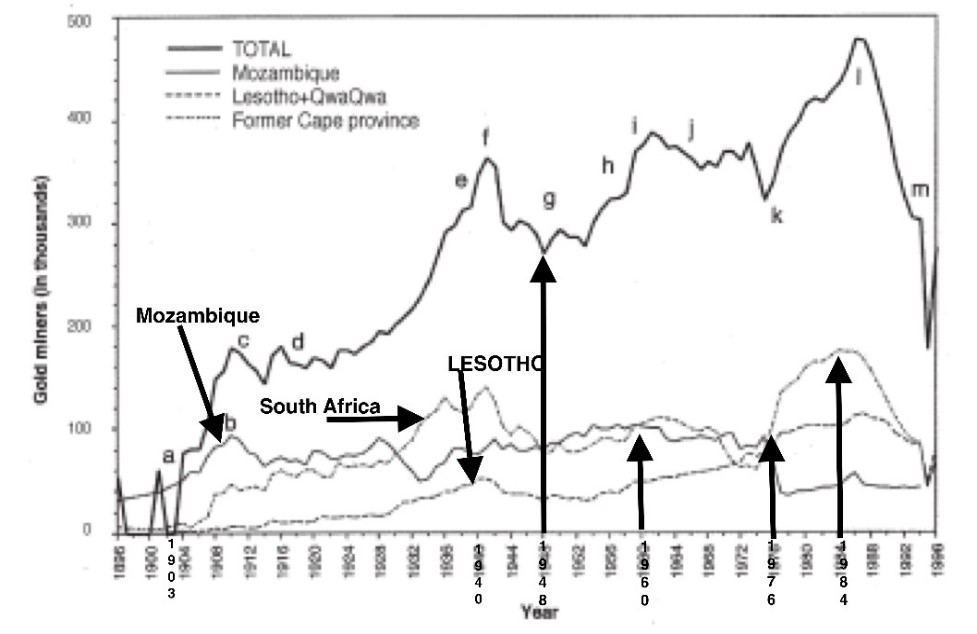
I assumed that mechanisation, resulted in improved production, and thus the increased value, how else could output just increase by 250% in fifteen years with the mining report not identifying the real reason.
What the mining report does not show, is that the production dropped by 40% during this period, production drops by 40% and value increases by 250%, what happened to the Gold Price?
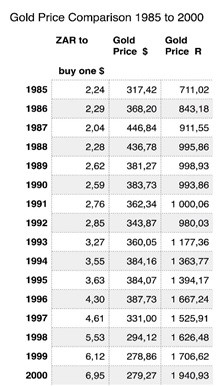
During the first IMF Loan, presented from 1985, to relate to the period when the labour is extruded, on table above, through to 1993, when the IMF Loan is arranged.
1985 to 1993, the Rand US$ moves from ZAR 2,24 to ZAR 3,27, a total of 45,98% 7mths @ = 6.57%
1993 to 1994, the Rand US$ moves from ZAR 3,27 to ZAR 3,55, a total of 8,56% 1mths @ = 8,56%
1994 to 2000, the Rand US$ moves from ZAR 3,55 to ZAR 6,95, a total of 95,77% 6mths @ = 15,96%
1985 to 2000, the Rand US$ moves from ZAR 2,24 to ZAR 6,95, a total of 210,3% 13mths @ = 16,18%
1985 to 1993, the Gold Price per US$ moves from 317,42 to 360,05, a total of 13,43% 7mths @ = 1,92%
1993 to 1994, the Gold Price per US$ moves from 360,05 to 384,16, a total of -12.01% 1mths @ = -12.01
1994 to 2000, the Gold Price per US$ moves from 384,16 to 279,27, a total of -27,31% 6mths @ = 1,92%
1985 to 2000, the Gold Price per US$ moves from 317,42 to 279,27, a total of -12.01% 13mths @ = -0,9%
1985 to 1993, the Gold Price per ZAR moves fr 711,02 to 1177,36, a total of 65,58% 7mths @ = 9,37%
1993 to 1994, the Gold Price per ZAR moves fr 1177,36 to 1368,77 a total of 16,25% 1mths @ = 16,25%
1994 to 2000, the Gold Price per ZAR moves fr 1368,77 to 1940,83, a total of 42,23% 6mths @ = 7,03%
1985 to 2000, the Gold Price per ZAR moves fr 711,02 to 1940,83, a total of 172,9% 13mths @ = 13,33%
What is the cause of this phenomenal increase, an increase when the world gold price reduces, yet still allows the mining industry shareholders to benefit, at no abnormal cost to the investors, very simply the manipulation of the Rand / USD exchange rate? The increased profit margins, is directly paid for by the South African citizens, through our large imported product requirements, at the depreciated rand value.
We know look at how the Gold price moves from here.
Pamphlet 27
South Africa no longer has economic gold reserves
2009 Gold Forecast;
The report dated 2009, comes to my attention while investigating the President Jacob Zuma first term, I become aware of the serious implications of the forecast, however, my presentation that Gold is reaching a level of ‘uneconomic’ removal, and thus the Gold Investors will be moving on shortly, initially does not find space in Human Dictate, but in Revision 3, it does.
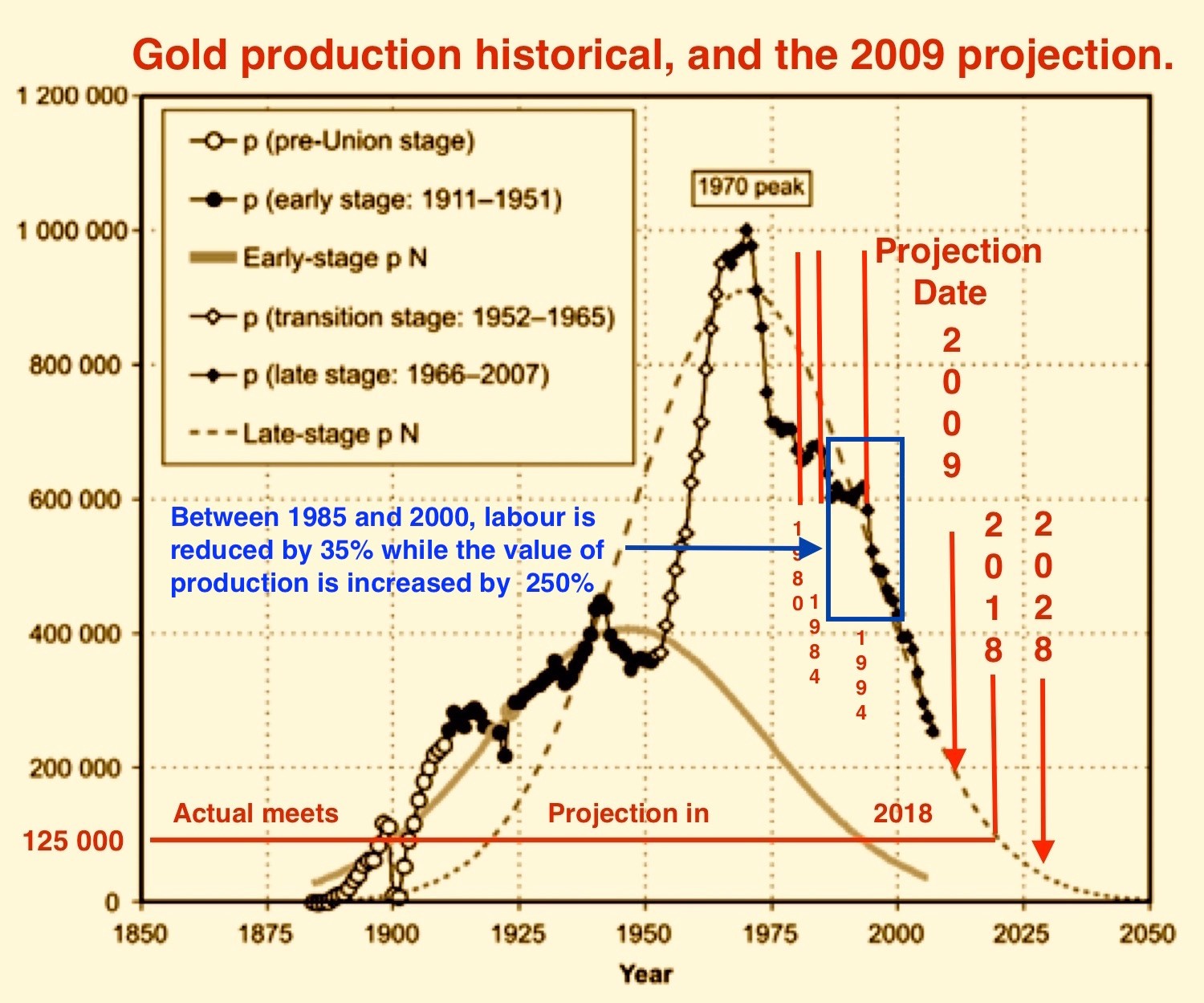
Cedric’s short ramble:
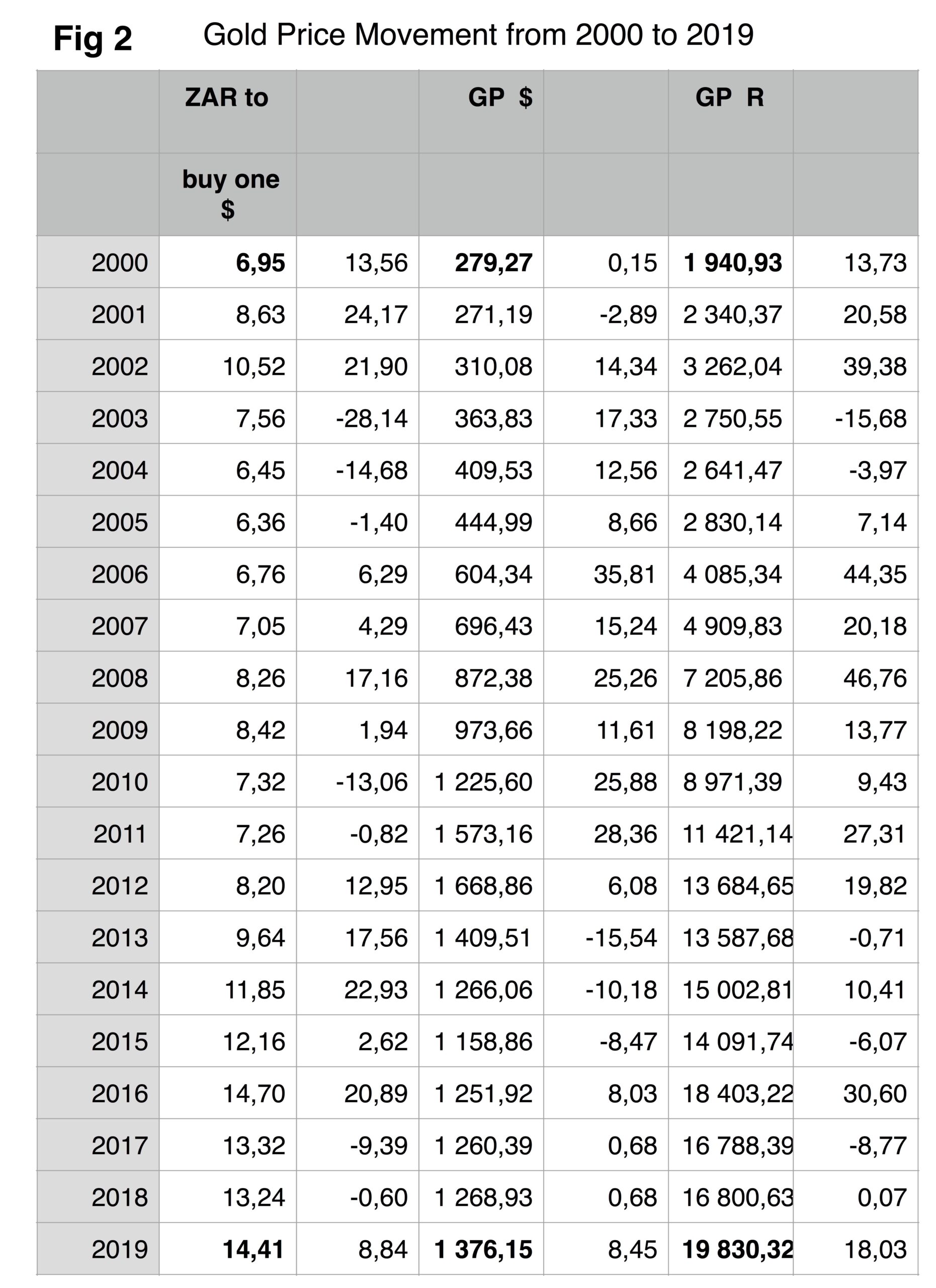
1: The 2009 projection, results in the Gold Price, moving from USD 973,66 to 1 668,86, by 2012, a typically related to diminished production.
2: The Rand remains stable during this period.
3: Gold Prices reduce, and Rand depreciates from 2013.
4: 2018, nine years after projection, production forecast of 125 000 is accurate, confirming serious implications.
AngloGold Moving On
This Business Day report, dated October 28, 2019, typically blames the South African people and Government blame for moving on.
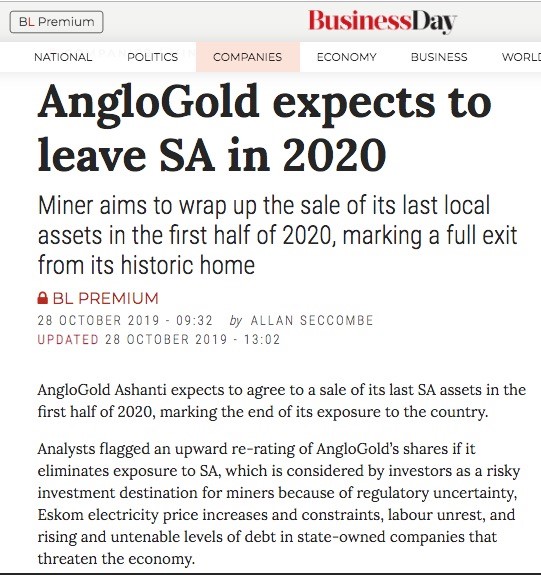
The Media report makes no mention of the 2009 projections and the 2018 production level.
Let us have a look at the impact of the ‘investors’ comments on the Gold Price, and the Rand Exchange:
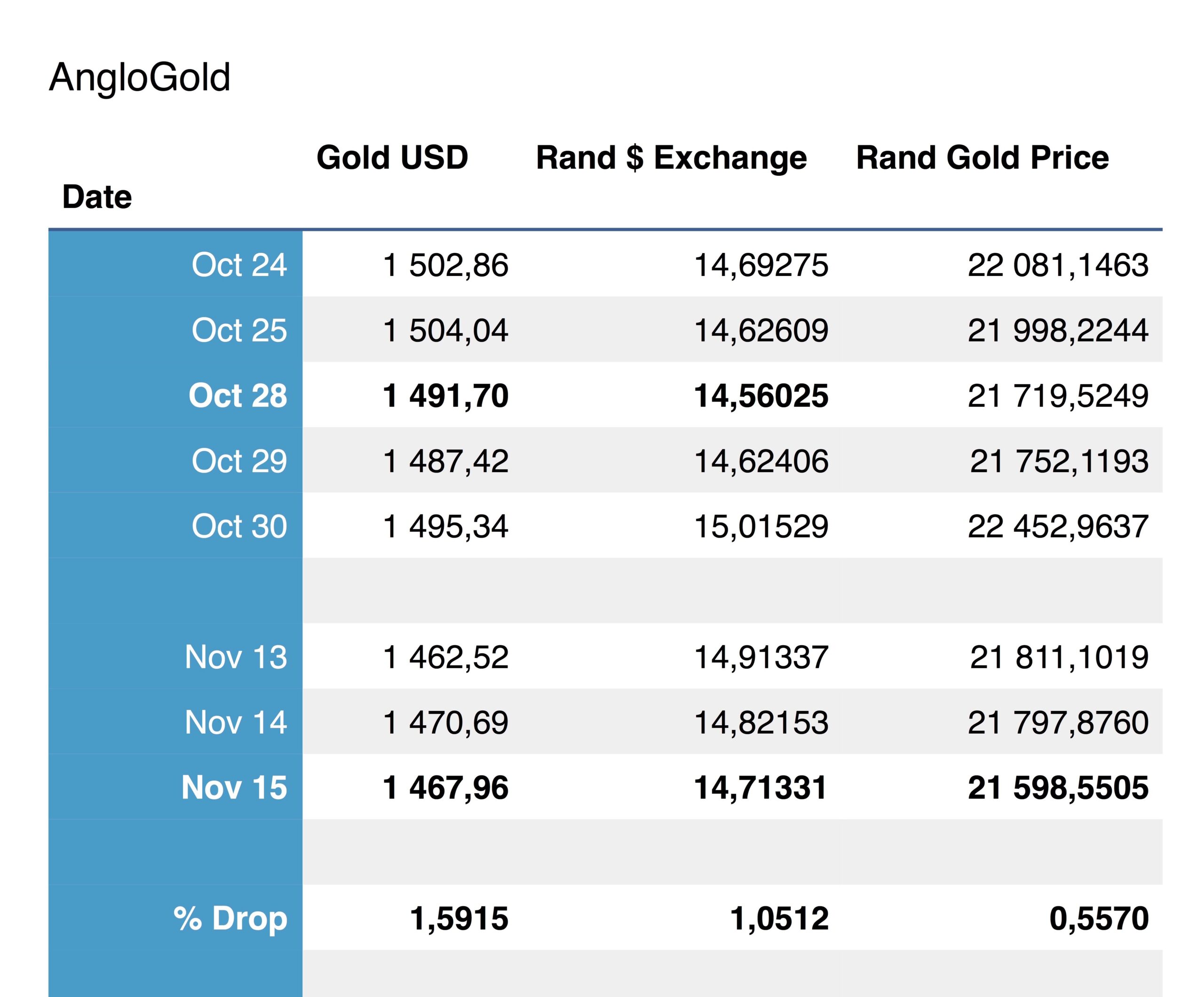
The Gold Price decreases by 1,59% from the announcement to Nov 15, unusual, in terms of potential production drop, the price should have increased.
The Rand exchange rate depreciates by 1,05% , yet the Rand Gold Price only decreases by 0,56%.
How can South Africa survive the “Neo-Liberal Global Market”?
I start with a short list for consideration, a list of products that we must start manufacturing locally, this is essential as phase one;
Clothing: All clothing products should be manufactured, packed and distributed locally.
School Clothing must be first on the list, imagine how many mothers and gogo’s can earn income is they were not competing with the Global Market.
School Shoes must be produced by the Township / Native Village community, with limited equipment.
This can only be achieved if we introduce Tariffs to protect,
Furniture: All furniture products should be grown locally, converted, packed and distributed locally.
School Furniture must be local.
Chicken: All chicken products should be cultivated locally, converted, packed and distributed locally.
No Frozen Chickens should be imported.
Agricultural: All agricultural products should be grown locally, converted, packed and distributed locally.
The Citizens pay, the Latipac, will play.
Top Priority Repetition:
Canadian Prime Minister, Mark Carney,
Davos 2026 Speech
Let me be direct. We are in the midst of a
rupture, not a transition.
“Living the Lie.”  ...  provided we lived the lie,
the “rituals” that are performed at great cost,
along with the rhetoric, will hide the ‘reality’
from both the beneficiaries, those accumulating
wealth, or those “powerless” who became the
consumers, the losers, the failures, those whose
wealth and livelihoods
we were systematically removing.
Barefoot Scientist, Cedric R de la Harpe
University of Knowledge – Soweto
H. v. Europeaus H. v. Afer3&5
This qualification,is also my signature, shows a
European, H.v. Europeaus, whose mind-set is
dominated by the Sub-Saharan H.v Afer,
#3 Behaviour, and #5 Governance patterns, expressed
through the math' “to the power of” symbol.
safari@tasteofafrica.co.za. Link to A R 05
| Eradicate Corruption to Eradicate Poverty |
[1] “G20- Report, the “Inequality Emergency” as presented by G20 2025 President, Cyril Ramaphosa, as the G20 split takes place, this dissertation is also addressed to US President Donald Trump.
[2] https://www.theguardian.com/commentisfree/2013/jun/24/anc-faustian-pact-mandela-fatal-error